Category Archives: 2nd through 4th grade

The Lost Ring: An Eid Story by Fawzia Gilani-Williams illustrated by Kulthum Burgess

Standard

The Lost Ring.jpg

This is a good little story about Eid ul-Adha for 2nd through 4th graders.  It is not AR and at 29 pages it balances information about Islam and Eid with a simple little story that keeps the target demographic interested.  It isn’t great, but for a book that would probably be a level reader equivalent of a three, it suffices in being a bit of a mystery, a bit of a comedy, and bit of a lesson on why and how we celebrate Eid.

Rahma’s Grandma and cousin, Muslimah, are visiting for Eid. The girls start off the story trying on their beautiful dresses and feeling like princesses.  The girls and Grandma then get to work on making samosas for Eid.  Rahma sees her grandmother’s ring next to the bowl of dough and tries it on. The story moves fluidly and the girls take turns helping  with the folding of the samosas.  Some more adults come in and add tidbits to the story about giving gifts on Eid and getting ready for Salat and depicting a typical practicing family.

The story shifts to dad asking the kids what they remember about Eid-ul-Adha and what they know about Eid-ul-Fitr, the Festival of Sacrifice. On the day of Arafat the children fast, visit the hospital and take gifts to people in the community and the neighbors.  After Salat-ul-Maghrib dad reviews some of the sunnah acts for Eid as well.  It doesn’t get too preachy, or overly detailed, it is more highlights and brief summary revisions.

Eid day is fun and exciting, but when night falls and the family prepares for people to come over, Grandma can’t find her ring.  The kids want to be detectives, but Rahma suddenly realizes that the ring must be IN one of the samosas. So the children decide to eat them all to check. When the ring doesn’t turn up, Rahma and her cousins recite Ayat-ul Kursi, ask Allah for help and decide to tell Grandma the truth.  Just then Mum yells and the ring is found in her samosa, the truth is revealed and they all enjoy a good laugh and resolve to “always remember this as the Samosa Eid.”

The Lost Ring inside

There is a lot of text on the page, and a fair amount of “foreign” words that I think the book is probably meant for Muslim children, or those familiar with the basics of Eid.  There is a Glossary in the back, but it still might be a bit too much for non Muslim children to grasp without someone to answer their questions. The illustrations have the elder females with hijab and the girls uncovered when not praying.  The small pictures are detailed and complimentary, but the younger readers will wish they were a bit more engaging.  Overall, a good book to have in a classroom, and a great one to check out from the library to encourage young readers, or just to enjoy before Eid-ul-Adha.

Lailah’s Lunchbox: A Ramadan Story by Reem Faruqi illustrated by Lea Lyon

Standard

Lailah's Lunchbox

Another standout in a crowded field of Ramadan picture books, mashaAllah, Lailah’s Lunchbox works well even outside of Ramadan for Muslim and Muslim children alike.  In 32 pages, the reader gets to know Lailah and understand how hard it has been for her to move to America from Abu Dhabi, make new friends, how nerovus she is to be identified as different, as well as how excited she is that her mother has finally agreed to let her fast this Ramadan.

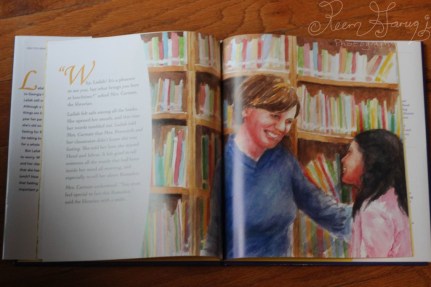
Lailah is excited to wake up and have sehri with her family before heading to her new school, fasting for the first time.  Her mother has written a note for her teacher, but on the bus, Lailah reads the note and suddenly worries if her teacher will even know what Ramadan is ,and decides not to give it to her teacher.  Lunchtime arrives, and when the teacher asks Lailah if she forgot her lunch, her voice fails her, and her classmates offer to share their lunch with her.  Lailah decides to leave the cafeteria and finds herself in the library spilling all her worries and stresses and fears to a kind librarian.  (Yes the librarian is the hero, and really no one should be surprised, right!?) With the librarian’s urging and Lailah’s determination, she writes a note to the teacher explaining that she is Muslim, and fasting, and even includes a poem.  She leaves the note on her teacher’s desk at the end of the day.  The following day, the teacher has written her back and the reader, along with Lailah, know that having courage and staying true to one’s self can often be scary, but also wonderful too.

lilah inside

While the story is billed a Ramadan Story, it really just is the back drop for a lot of really good messages.  I think 2nd and 3rd graders to early middle schoolers could really benefit from the book.  It is semi autobiographical and I think the authenticity of the emotion woven in, makes the book very relatable and powerful.  I plan to discuss it with my daughter going in to 5th grade, who is also a bit shy on occasion: the way Lailah worked out the problem, the way she found someone to trust and talk to that was patient with her, to point out to her that the kids in her class were very kind and that most of her fear and anxiety was with herself, not them.  I also really like the message that she was so excited to fast, and how her nerves took that excitement away, but having the courage to face her fear, brought back her happiness and enthusiasm.

The end of the book has an Author’s note, telling how the story came about and a bit more about Ramadan. It also tells the definition of Sehri and Iftar, the only two “foreign” words in the book.  I found it interesting that the word Sehri, an Urdu word, was used instead of Suhoor, if they are coming from Abu Dhabi, but perhaps the author is of subcontinent heritage.  The illustrations are colorful and realistic, complementing the story and tying in the range of emotions and events Lailah is experiencing.

I was pleasantly surprised at the book, and even more excited to see that it is available in the public library system.  Here is the link to the author’s blog I hope she plans to write more, as her style and message resonate with Muslim American kids, and their parents, alhumdulillah.


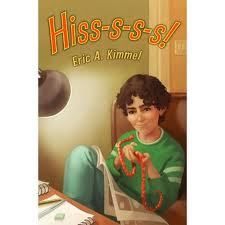
Hiss-s-s-s! by Eric Kimmel

Standard
Hiss-s-s-s! by Eric Kimmel

Hiss-s-s-s!

So um ya, its a book about a boy who wants a pet snake. Very linear, very simple, often more instructional than story, but somehow I really enjoyed it and read it in one sitting, as did my 9-year-old daughter and 7-year-old son. The book is 154 pages (including the author’s note) and is written on an AR 3.7 level.

SYNOPSIS:

Omar is an American Muslim who wants a snake.  His dad, Ahmed, supports the idea, but his mother, Hoda, is terrified of snakes, and begrudgingly gives her permission.  The rules are pretty simple, Omar will have to take care of the pet, and it is never to leave his room.  His mother basically doesn’t want to know that there is a snake under the same roof.  Little sister Zara is just excited.  The majority of the book is Omar learning about corn snakes, and everything involved in their care.  There are a lot of lists, and passages about him researching and taking notes. His friend Philip, nicknamed Samkatt-short for Samurai Cat, is the comical sidekick, who in this case also is the brains in the group, keeps the plot moving along. The author sprinkles in some anecdotes and history giving the characters depth.  We learn Ahmed’s dad is from Pakistan and while he grew up in the city he spent time in the country and with snakes.  He retells a fictional story about how snakes kept the rodent population down, and thus allowed the farmers in his family to have higher grain yields.  He also tells Omar tidbits about his time in college working in a biology lab with snakes.  Omar’s mom is an accomplished artist that often incorporates her Lebanese culture into her work and gallery shows.  The banter between her and Samkatt keep the story light and entertaining.  (SPOILER ALERT) At the climax, the snake gets loose, and Omar learns where his mother’s phobia comes from in her childhood.  During one of Lebanon’s many wars, a man with a snake tattoo beat her father extensively while she was forced to watch.  This somehow over time developed in to Ophidiophobia, the fear of snakes.  When the snake pops up, mayhem ensues, resulting in Hoda going to the hospital and Omar having to decide what to do with his snake, Arrow.

WHY I LIKE IT:

It is such a simple story, yet the warmth of the characters at the beginning and end really made it enjoyable.  I truly applaud the author for stretching a very simple idea into a full fledged YA novel.  The characters and family are Muslim, but it isn’t really discussed or made an issue.  There is nothing religious talked about or detailed.  In some ways, it would have been nice to throw a little more cultural or religious depth in to the story to connect with the characters, but being as the author is not Muslim it is kind of impressive that he presented them as just a regular American family.  Culturally there are only a few references outside of the anecdotes the parents share: Omar can’t come up with an example of when he was bullied, some of the foods served or eaten, the mother’s art work.

FLAGS:

None. Even if you don’t like snakes, the book should not make you squeamish.

TOOLS FOR TEACHING THE DISCUSSION:

There is not much to discuss with the book, and thus I wouldn’t choose it for a book club pick.  I think 2nd or 3rd graders, however,would do well with the book in small groups.  There is just a tinge of foreshadowing, symbolism, and interpretation that wouldn’t overwhelm the student, but would boost their confidence when they connect the dots so to speak.  Plus, some discussion could come from how he had to persuade his family, the responsibility he had to show, and the sequencing of events. The worksheets and questions would practically write themselves.

Author Eric Kimmel’s blog about the book http://ericakimmel.com/2012/02/h-i-s-s-s-s-s/