Category Archives: Non Fiction

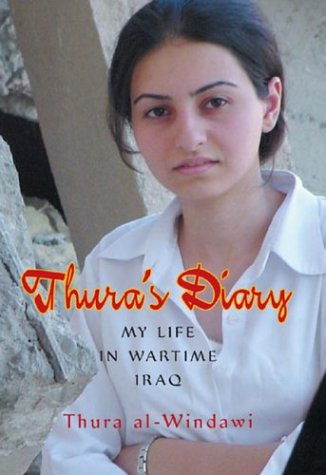
Thura’s Diary: My Life in Wartime Iraq by Thura Al-Windawi Translated by Robin Bray

Standard

Thura's Diary

It has been a while since I’ve read a wartime diary from a young woman’s perspective, but if memory serves, both Anne Frank: The Diary of a Young Girl and Zlata’s Diary: A Child’s Life in Sarajevo, not only enlightened me to what living through the atrocities was like, but also emotionally established a connection of how horrific the truth of war really is; this book unfortunately, did neither.  To give it the benefit of the doubt I am now reading it as an adult, which may have changed my expectations and hardened my understanding of war, but very little in this 136 page book was memorable to me.  An AR level 6.1 the book is a quick read with some odd footnotes and definitions on each page.  I’m assuming the translator wanted to make sure the book flowed, but for some reason the bold words and obvious definitions annoyed me.  The center of the book is filled with pictures of Thura and her friends and family in both England and Iraq, which I found misleading since she never really introduces us to her friends so frequently pictured.  Overall I felt like I had more questions about what her life was like during 2003 then she answered.  I understand that it reads like a rough draft, because it is presumably her true diary, but it seems if you were going to publish it you would flesh it out a bit, explain why you ended up not going to the countryside on various occasions, explain your father’s role in the Baath party, what happened with your BBC interviews, explain why you feel that women have no rights, did you feel this way before shock and awe? What did you come to America to study? etc..

SUMMARY:

Nineteen year old Thura is in Pharmacy School when news breaks that the coalition forces are going to start bombing Iraq.  Her family is middle class, religious, but liberal, and as they prepare for the inevitable their lives become uncertain to say the least.  The oldest of three daughters Thura attempts to articulate the fear of bombs falling, the anxiousness of what will happen to their homes, friends, and families, while not necessarily being “adult” enough to be privy to all information to share insight into the rational that is now her life.  At times she seems to whine about her situation, and at other instances she has patience and maturity to appreciate that they are safe and together. The choppiness of why one day she is able to go to the journalist’s hotel, but the next day can’t leave, and her back and forth feelings about school are never explained and leave holes in her narrative.  If the intent is to explain what life in wartime Iraq was like, relying on the readers to fill in the gaps is counter productive and inaccurate.

WHY I LIKE IT:

I like that it is written by a young, modern girl, and is a conflict that in many ways is still ongoing, and providers children today with some insight beyond the headlines.  The book on the surface will allow a dialogue to take place potentially forcing students to imagine what their lives would be like in a similar situation, and how quickly the safety and security you feel can be uprooted.  She is a relate-able figure in that she is in college and she worries about her friends and family.  It is also a fairly easy read.  Non-fiction for many is dry and factual and this book reads more like a story, which I think would appeal to many students, particularly those with ties to Iraq.

FLAGS:

The book does use strong language on a few occasions: hell and bastard.  It also mentions pornography a few times, in the context that once Saddam is overthrown pornographic magazines and films are becoming commonplace and it makes her uncomfortable.  She mentions that culturally growing up she is even “embarrassed just to hear the word ‘sex’.”

She is very anti hijab and it isn’t explained why.  She discusses religion in a more cultural way, but does discuss reading Quran on one occasion, and mentions the masjid. As a whole, it doesn’t seem to be a big part of her life, but obviously is a part of her environment.  She mentions the lack of women’s rights and her frustration with her own people preventing her from moving about uncovered after the soldiers occupy Baghdad, but not knowing why she is against hijab specifically leaves a lot of guesswork that could be taken many ways in the reader’s mind.

TOOLS FOR LEADING THE DISCUSSION:

I don’t know if I would do this as a Book Club book.  I would probably discuss it with the Middle School Social Studies teacher and see if it could supplement a lesson or be offered as extra credit perhaps, but because there are such holes in the narrative I would be nervous to be presumptuous about what she means, or what was going on in certain places, being that it is a work of non-fiction.

A 7th grade lesson plan: http://chippewavalleyela.pbworks.com/f/Gr+7+Unit+3+Teacher+Lesson+Plan.pdf

The copy I read has questions and things to consider every few pages and an “Exchange” on the back inside cover with ideas, questions, and reflections outlined.

How to Get Hijab Ready: A Guide for Muslim Girls Ages 8 to 11 by Aisha Elwan & Megan Wyatt illustrated by Sarah Hafeez

Standard

How-to-get-Hijab-Ready

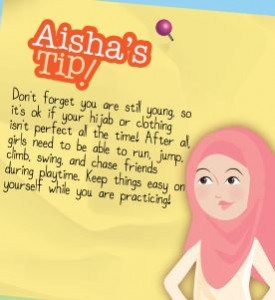
Yes I know it isn’t fiction, but How to Get Hijab Ready is such a fabulous and much needed book that any positive attention I can direct toward it, I feel is effort well spent, Alhumdulillah.  The book is obviously meant for 8 to 11 year old girls contemplating hijab.  The beauty of this how-to book is that it answers everything from how to accessorize one’s hijab to dealing with bullies in a beautiful manner.  Not only are the pictures bright and colorful, but the presentation is clear, precise and inspiring.  The authors do not talk down to the readers, nor do they make it seem like a burden as they discuss hadith, ayats from the Qur’an, challenges and fashion sense.  The book is divided into sections: The Basics, Getting Started, Having Conversations,  Worries and Concerns, and finally Your Reward for Good Deeds. Each section addresses different topics and “Aisha’s Tips” are scattered throughout to give 12-and-a-half-year-old Aisha’s tips on the subject at hand.

Aishas-Tip-275x300

Truly this book is a gift to moms and daughters alike.  I plan to let my daughter look through it for a few days and then sit down with her to discuss.  It functions as both a how-to manual as well as a reference guide and I can see it being looked at A LOT.  Additionally I can see my daughter discussing it with both Muslim and non-Muslim peers.  I think the book offers confidence, direction, and pride as young girls will find inspiration from young Aisha while having many of their concerns about hijab answered in a fun, hip way.

My only criticism is that it wasn’t around when I was a young girl.  For some hijab is an unknown, for some it is a stress, and for some it is a natural expression of faith, and subhanAllah this book in just 51 colorful pages manages to convey information, smiles, and excitement irregardless of your background.

project-708-body-Screen_Shot_2015-02-21_at_11.49_.38_AM_

Iqbal by Francesco D’Adamo

Standard
Iqbal by Francesco D’Adamo

iqbal

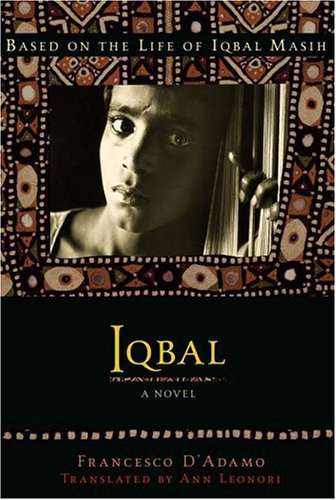
Iqbal is the fictionalized story of the young Iqbal Masih, a real boy who escaped virtual slavery in a carpet factory to fight against child labor in Pakistan.  Although the book is a short read at only 120 pages, it is heavy in content.  The description of the children who work all day often tied to their looms to make the beautiful carpets desired all over the world, is both incredibly gut wrenching as well as inspiring.  The book has an AR level 5.1 and while the author and main character are not Muslim, most of the minor characters presumably are, as is the environment.  I am using this book for our new Book Club book because the message and determination of young Iqbal is something middle school students should feel empowered by, inshaAllah.

“So long as there’s a child in this world who is deprived of his childhood, a child who is beaten, violated, or exploited, nobody can say it’s not my business.”                                 …Iqbal

SYNOPSIS:

The story is told from the voice of a young girl, Fatima, bonded to a carpet weaver where Iqbal joins her and a handful of other children who are forced to make carpets to pay off their parents’ debts.  Iqbal has a reputation as being the best carpet maker and is rumored to have made one of the most difficult designs for a former master.  While good at what he does, Iqbal combats the naivety of the other children by pointing out that they will never be allowed to leave, even if they manage to pay off their debt.  This slow realization empowers all the children with Iqbal as their leader to dream of freedom, and to stand behind Iqbal as he dares to do more than just dream.

WHY I LIKE IT:

I like this book because it is vivid in detail and really takes the reader to a place they have never seen, nor thought about.  To read about another’s life paves the way for the reader to develop understanding and empathy, characteristics most middle school students rarely exhibit.  The fact that it is based on a true story, in the recent past, really hammers these concepts into the reader and changes the way one looks at hand tied carpets, and child labor in general.  I think it also makes the reader appreciate their own life, their own freedom, and educational opportunities even more.

FLAGS:

The book is clean, but the concepts are for older kids.

TOOLS FOR LEADING THE DISCUSSION:

Unit Plan:

Click to access iqbal-unit-plan.pdf


Summary with pictures:

http://desk2.sd8.bc.ca/web1/Elementary/Iqbal/iqbal.htm


A

Muhammad (SAW) By Demi

Standard

muhammad-cover-pic

This book attempts the enormous task of creating a picture book biography for kids about Prophet Muhammad (Peace and Blessings Be  Upon Him).  While the text seems adequate and engaging for children with a basic knowledge of RasulAllah’s life, I think it would overwhelm any young non-Muslim reader.  The story starts with Prophet Muhammad’s birth and tells about the major aspects of his life, both as a family man and as a leader.  The text includes ayats from the Qur’an and hadith.  THe information is presented as fact, it doesn’t preface statements by saying, “Muslim’s believe,” making the book a solid, yet dense, book for Muslims of all ages and a good introduction to Islam and Prophet Muhammad (pbuh) for older non-Muslims as well.

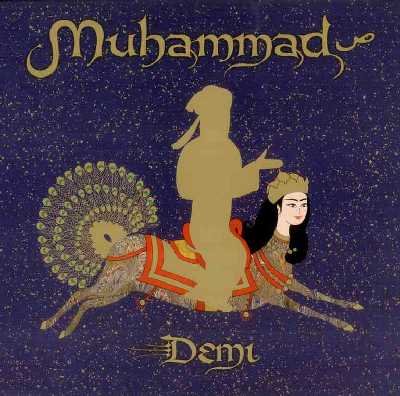
The book has an AR level of 6.7 and is beautifully illustrated.  Some of the illustrations are borderline irreverent, but it is clear that Demi truly respects the Islamic tradition of not depicting Prophet Muhammad (pbuh).   I think it is more jarring because most Islamic books do not depict the angels, buraq, or any of the prophets, where Demi does in her book.  Prophet Muhammad is depicted by a gold silhouette and the proper blessings are bestowed upon him whenever mentioned in the text.

Demi includes a foreword at the begining of her book that explains some of the diction choices and background on the artistic style used, there is also a bibliography at the end of her 42 page story.  The book is ok for independent readers or in small groups to discuss, however for anyone younger than 3rd grade, it is probably just too much information.

Ramadan by Susan L. Douglass Illustrated by Jeni Reeves

Standard

ramadanThis is a non Fiction book about Ramadan that is thorough and accessible.  It has an AR level of 3.7 (third grade, seventh month), and with the short sentences and well-spaced text, I wanted to include this book so that those looking for an informative book for their independent readers (second grade and up) would consider this one.  At 48 pages, the book isn’t divided up into chapters but there are headings that keep the book flowing from one topic to the next. The illustrations supplement the text giving them context and there is a list of “New Words” in the back making this book appropriate for Muslim and non Muslims alike.  

Overall a good read for those looking to learn more about Muslims and Ramadan, or for those looking to see themselves in a book that isn’t too childish. The book is clean and factual, and keeps a nice balance between giving solid information and overwhelming the reader with details.  The book also includes examples of Ramadan in other countries as well as students fasting in America.  We have this book in our school library and the students that have stumbled upon it are excited to check it out, and when they ace the AR test they are absolutely beaming.  


Rashad’s Ramadan and Eid al-Fitr by Lisa Bullard Ilustrated by Holli Conger

Standard

rashads ramadan

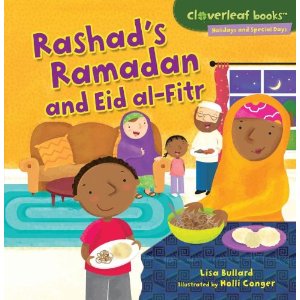
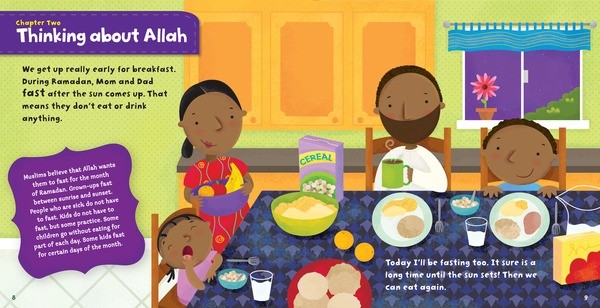
This is a non fiction picture book that tells a very basic story about Ramadan through Rashad’s young voice, with informative sidebars giving facts and details about Islam, Ramadan, and Eid. Broken into four chapters the book is very concise at just 24 pages, highlighting the key aspects of Ramadan: Where’s the Moon, Thinking About Allah, Thinking About Others, and  A Big Celebration.

?????

With an AR level of 2.7 this book is perfect to read along with your child, Muslim or non, letting them read the story, and you adding the information and answering any questions they may have about Ramadan.  There is a glossary in the back, as well as a page of “Resource Information” to learn more.  It may seem a bit “childish” for some, but it is a great introduction, and/or a good review of the basics for toddlers to third grade.

The pictures are bright and colorful, yet simple enough to not overwhelm the information being conveyed.  They definitely make you smile to see the little smiling faces and convey the excitement of the holiday.

I Am Nujood, Age 10 and Divorced By Nujood Ali with Delphine Minoui

Standard

nujood

I don’t often read non-fiction, but like I am Malala, I am Nujood , Age 10 and Divorced seemed too compelling to turn down, plus it isn’t a long book, just 188 pages even with the epilogue, reading group guide, notes and acknowledgements.  Written on a 6.2 reading level, the story of this young girl, is not well developed.  Her plight is powerful, but the telling of her story is awkward, unrelatable and in no way does her justice.  I never felt a connection to Nujood, naturally on the premise I was cheering her on, but I would have cheered anyone in her position on.  I don’t feel like I know her, or know her family, or really any characters in the book.  It seems that Delphine Minoui  tried to write the book as if she were Nujood, a ten year old with minimal education,  instead of finding away to balance Nujood’s voice and story, while adding the detail and back story to give the reader a connection and understanding to what and why this was allowed to occur.

SYNOPSIS:

Nujood is a Yemeni girl from the small mountainous village of Khardji, after scandal rocks the sister just older than Nujood, there are too many kids that the order and ages of them all is a mental workout for her mother, the family leaves everything and moves to the city of Sana’a.  Poor and with little hope, Nujood is given/sold to a man three times her age.  After months of abuse she sneaks away and finds a judge at a court house where she finds courage and her voice to proclaim, “I want a divorce.”  From there she must recount her story to both lawyers, journalists, and anyone that can help her as she works to break a long tradition of girls marrying young and save herself.

WHY I LIKE IT:

I like that something that is perhaps a societal norm in Yemen was made public and that we can hopefully now do something to help these young girls.  I don’t think it would work as a book club book or a novel study in a middle school setting as the details of rape and drug use are present.  They are not explicit, but I think that sharing excerpts from the book would be sufficient in explaining why this is such a tragedy and needs to be stopped.  The characters are all Muslim with various levels of belief and practice. While sad and heartbreaking, her story is hopeful at the end.

FLAGS:

Details of her rape, her sister’s affair is mentioned, and some minor drug use is common amongst the men.

I am Malala By Malala Yousafzai and Christina Lamb

Standard

malala pic big

Naturally we all have heard Malala’s story and while some are inspired by it, some seem to have major hostility toward her and her approach.  Chosing to take her at face value and be inspired by her, I was generally looking forward to reading her story before I ever entertained thoughts of using it as a teaching tool in a school.  It is an AR reading level of 7.1 so once I obtained the book I rushed to read it before the end of the school year to see if perhaps our 7th and 8th grade students could read it and leave for the summer realizing the blessing that an education can be from someone who has had to risk it all, just for the chance to learn.  However upon completion I think that the dates, and history of Pakistan would ultimately drag the book on for the majority of Middle-Schoolers and her message and inspiration would be lost.  For adults looking for a book club book however, I would highly recommend it.  As a half Pakistani-American growing up spending my summers in Pakistan, I could relate and recall so much of what she wrote about.  I think most adults of any background would similarly be able to recall major news events, and be able to follow along.  I think anyone younger would find it incredibly difficult and possibly dull to get through.  I think that students would benefit from learning about her story and then only reading excerpts from the book.  There are some very moving sections that I think the average middle schooler would be impacted by, and the included pictures amongst the 327 pages would give them a glimpse into her world.   I on the other hand, couldn’t put it down, the book reads very quickly and bounces around all over the place, which actually didn’t bother me, I enjoyed her descriptions of her town and family and friends.  While Malala wrote it with an author, I think the tone is very much that of a young girl and thus the style works for me.  Political views aside the book made me smile, made me cry, and makes me feel better off having read it.

SYNOPSIS:

Malala is a Pashtun girl in the Swat Valley in Pakistan.  In a culture that keeps females behind doors and cloth, her father is the anomaly and encourages her to be educated, free, and vocal.  As 9/11 occurs, the Taliban sets in, the west wages war on Afghanistan, Osama bin Laden is killed, governments change in Pakistan, floods and earthquakes destroy the land, Malala and her family struggle to survive, improve their community, and advocate for the right of women to be educated.  All this climaxes in the Taliban boarding her school van and shooting her in the face at point-blank range.  She is then rushed to various hospitals before being taken to Birmingham, England. 

WHY I LIKE IT: 

It gives hope and shows that there are people making a differences and despite the risks, do want to change things in the world.  It is a great example that one person can make a difference.  Her family and her are active Muslims, that reflect on the Quran and try to understand where the Taliban is wrong in their interpretation.  Religion is a defining factor in every aspect from personal to culturally to government, and presents just how different each person seems to manipulate religion to their own benefit.   It might seem odd for some that she is writing this memoir of sorts when she has barely lived a long enough life to reflect back upon.  It also is perhaps overly optimistic as the story is ongoing, what she will do now is unanswered because it is not yet been given a chance to unfold.  I think the story is strong enough to cut through the criticism, and can be very powerful from both a child’s point of view, and from her parents.  Most readers if they can get through the intermingling of her story and that of her country will be affected by her plight.

FLAGS:

Violence, but done in a newscast style, not overly sensationalized, but details are given.