Category Archives: Historical Fiction

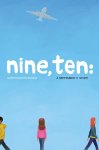
nine, ten: A September 11 Story by Nora Raleigh Baskin

Standard
nine, ten: A September 11 Story by Nora Raleigh Baskin

nine, ten.jpg

I still struggle with the fact that 9/11/2001 is taught as history, it seems so current and fresh in my mind, that I really struggle with how works of fiction (and non fiction too) try to tell me about the pulse and the mood and the impact of something that I lived through and recall so clearly.  I suppose this isn’t a unique predicament, but because of the magnitude, one that I still wrestle with.  The author of nine, ten glosses over the big picture and in a lot of ways, the events of 9/11, but instead tries to show the paradigm shift that occurred and the division drawn as life before and life after.  She attempts to do this on an AR 4.8 and in 197 pages.  No easy feat, but one that definitely has some hits, and for me at least,  a few misses too.

SYNOPSIS:

Told from four different perspectives that intersect at the opening and at the close, the reader meets the characters two days leading up to 9/11, spends some of September 11 with them, and then peeks in on them again a year later.  The characters all cross paths at Chicago’s O’Hare Airport.

The first character is Will.  A middle school boy struggling to come to terms with how his father died helping someone on the side of the road.  Often more responsible and mature for his age as he helps his mom with his younger siblings, he lives in Shanksville, Pennsylvania and finds healing with helping those affected by the plane that goes down there.

Next we meet Aimee, who has just moved to California and is starting a new school.  Her daily drama is more missing her mom who travels a lot to New York for business, but is relatable as she tries to make new friends, fit in, and find her place in a new environment.  Her mom is in New York during the duration of the book, and has a meeting in one of the Twin Towers on the 11th.

Sergio lives in Brooklyn, New York and is a math wiz who gets a special award and recognition for his achievements.  He lives with his loving grandma, but it is the stressful encounter with his deadbeat father that sets him on a fateful subway trip that introduces him to Gideon, a New York fire fighter.

Naheed is the fourth character, and is an Iranian American Muslim girl, who is struggling to handle friends, and new questions about the hijab she wears.  Her friend drama consumes her, until 9/11 happens and she has to now prove her love of America at every turn.

The characters each take chapters divided by dates and while short, they do form a connection in their snapshots.  You feel like you get to know the characters and you do feel a tinge of stress knowing how they are all related geographical to what will transpire on the 11th. But in the afterward, the author explains why she intentionally keeps the carnage at bay to show how connected we all are, especially children, at the forefront of her fictionally retelling, and to show how much we all were affected that day.

WHY I LIKE IT:

I like that breaking up of the story, it adds some dimension to the book.  I know some reviews feel it is over done, but I think it is deliberate, and highlights how we all are inter connected and for late elementary, early middle school readers, I think the choppiness it allows, keeps the book on their level.  I like that each character has their own struggles, it isn’t that life was rosy and then 9/11 ruined everything, these kids have their own issues and stresses and realistic personalities before and after.  I also like that the Muslim character is not from the Middle East, it further shows how groups get lumped together for different reasons giving the book a bit more for readers to consider.

There are however, some real issues in how they present Naheed, which seems odd, since the book is so politically correct, and given the topic, you’d think the author and editors would work overtime to get the islamic parts correct.  But alas at one point Naheed’s visiting Uncle wants to know why Naheed doesn’t pray the mid day prayer, thuhr, at school, to which the mom replies, “she makes up her prayers at third prayer.” What? Yes I laughed out loud, no one calls the prayers by their numbers! I have never used numbers to describe our prayers, they have names, and we use their timings to describe them to others, not numbers. At one point, Naheed is making wudu, ablution, and the author gets it wrong. “And lastly, feet.  Right foot with right hand. Left foot with left.  Toes to ankles.” Left hand for both feet.  I also take some issue with Naheed having to wear hijab at age nine.  Hijab becomes required at puberty, so yes it could have been when it became required of her, but it seems a little young for her, and it seemed a bit forced.

In terms of plot, I would have liked a day or two after 9/11 to juxtapose the differences in priorities and the lens of how we got to a year later, or two years later, or 15.  Also, how they all went to New York on the anniversary to tie the story together made for a nice ending, but why they all went was a bit of a stretch, ok a big stretch.

FLAGS:

For a book about 9/11 there is relatively no violence.  The only death is in talking about Will’s father and the only blood is when Sergio helps a man on the subway.  There is some hate speech at the end, but even that is minimal.  Will does kiss a girl he likes. And both Will and Sergio skip school.  Aimee worries if her mom is having an affair (implied) and if her parents are getting divorced, but it isn’t explicit.

TOOLS FOR LEADING THE DISCUSSION:

I think this would be a good book for a younger book club.  With its overt commitment to political correctness and breaking down stereotypes, it reinforces how similar we all are through strengthening bonds of humanity, rather than being divided by our skin color, or religion.  I think it would also lead so easily into faccilitating discussion of today’s kids putting themselves in the story.  What in their lives wouldn’t matter any more or what would matter more. There is a Reading Group Guide at the end of the book, along with an Author’s Note and Acknowledgement, that easily lend themselves to more discussion ideas.

Curriculum Guide: http://www.norabaskin.com/nine-ten-curriculum-guide/
 

Just a Drop of Water by Kerry O’Malley Cerra

Standard
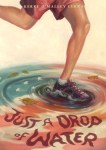
Just a Drop of Water by Kerry O’Malley Cerra

just-a-drop-of-water-cover

Thankfully the adult in me won out as I resolved to read a book whose cover and title did nothing to tempt me.  I know, I know, never judge a book by its cover, but seriously a kid running on the American flag with major Muslim characters, written by a non-Muslim about September 11th? I was hesitant and nervous to know what messages would be spread in the 304 pages to children on an AR 4.0 grade level.  But alas, I was  nervous for nothing.  The book is wonderful, and I want to read it again with my 5th grade daughter so we can discuss it.  It is hard to believe 9/11 is now taught as history, but as someone who lived through the tragedy as a college student, this book hit on so many of the defining moments of that horrific morning and the days that followed.  The book isn’t overly political, or judgemental, or preachy, and in retrospect, most people on September 11th and the days immediately following, weren’t either.  We were confused, scared, and unsure, a tone the book reflects and magically presents on an elementary level without getting  overwhelming with the enormity of it all .   The book was published two years ago, and I’m very tempted to contact the author or editor and urge them to reconsider a cover and title change because truly the story deserves it.

SYNOPSIS:

Jake and Sam have been friends their whole lives.  They bonded in the sandbox with their little green army men and have been planning battles and missions together ever since.  Told from Jake’s perspective the reader sees what life is like for these two 8th grade boys.  They push each other in cross-country, their parent’s come together for Jake’s 13th birthday, neighborhood boys swing by for pizza and front yard football games.  But there are stresses too: siblings, busy parents, not getting named captain of the team, friends that play dirty.  Then September 11th happens and worlds are shattered.  The boys learn that one of the hijackers, Mohammed Atta, was from their town, and although Sam has only been to the Mosque a few times with his grandparents, and his parents are culturally American not Saudi, the school bully Bobby is determined to get rid of Sam.  Jake makes it his mission to defend his friend with his fists and his words, but when his parents urge him to stay away from Sam, the stakes are raised.  President Bush says, you are either with us or against us.  But what is Jake to do?  Secrets about Sam’s dad come out and the FBI takes him away for questioning.  The town is gripped in fear and 8th grade boys on both side are determined to change the world, to be the drop of water creating ripples of change.  As Sam and Jake pull away from each other, Sam starts going to the mosque to learn about what he is being accused of being and begins to identify as Muslim.  Jake’s frustration with his parents continues to grow as does his impatience with Sam, but when Jake overhears Bobby plotting something serious, Jake will have to decide where he stands and how strong he is.

WHY I LIKE IT:

I like that the author crafts a story that is complex, but not overwhelming.  She sticks to focusing on getting inside Jake’s head and succeeds.  He is frustrated and confused and determined, but alas he is only a kid and can’t foresee his actions or articulate them the way an adult can.  He is likeable and fallible and she doesn’t belittle him, thus making his plight tangible and relatable.  I was a little disheartened when about a quarter of the way in it was made clear that Sam knows nothing of Islam or his culture, but it works so well in the story to show that he was pushed to go learn about his roots, since others were treating him as if he represented Arabs and Muslims.  This is so real, I knew so many non practicing Muslims that suddenly started coming to the mosque or reading books on Islam because they realized they should know where they come from.  Many resumed a secular life over time, but many also became more practicing, a phenomenon, the US media and politicians have seemingly failed to acknowledge as Islamaphobia is rampant and so many people pick up a Quran to see how a religion painted so negatively, can simultaneously be one of the fastest growing religions in the world.  The author doesn’t even touch on what Muslim’s believe, but she does include that they abhor violence and disavow the attacks.  The Sheikh is presented as nice enough and there is no negative judgement or tone from the author, aside from the xenophobic characters.

The title of the book comes from a song that Jake’s grandma likes and she often tells Jake, “just a drop of water.” Jake takes it to mean that something is insignificant, but she has him listen to the song and explains that it makes ripples that grow.  The imagery is great, and the line becomes powerful, I guess I just felt it wasn’t devolved or woven in enough to make a strong, clear statement to be the title of the book.  I’m sure many would disagree with me, but as I stated earlier the title along with the cover photo didn’t pull me in.  The book appeals to both girls and boys as both are presented very positively.  There are a handful of side stories that add depth to the characters and narrative that I haven’t touched on, but they are all charming in their own way.  There is a Boo Radley type character, there is a whole tangent about Jake’s grandfather and the details surrounding his grandfather’s death, and the overall messages about friendship, and doing what’s right that make the book relevant to a wide spectrum of readers of all ages.

FLAGS:

The book is remarkably clean considering it is about an act of terror followed by bigotry.  There is some hate speech and violence, and some lying and cheating, and mention of getting pantsed.  But, overall clean and no concerns for 4th grade and up.

TOOLS FOR LEADING THE DISCUSSION:

There are a lot of resources online and it doesn’t surprise me.  This book would do great as a novel study, as it is historical fiction.  It would also work well as a book club selection for any elementary or middle schoolers, not just those in an Islamic school.

Core Connections: achievethecore.org/file/1602


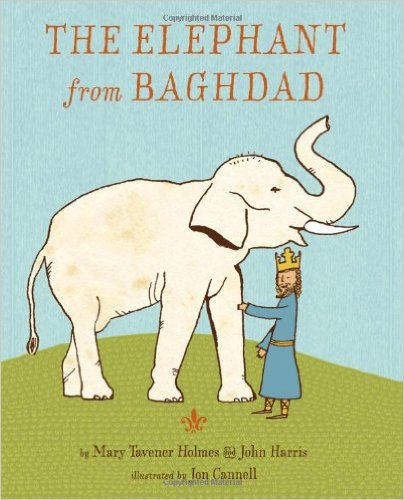
The Elephant from Baghdad by Mary Tavener Holmes and John Harris illustrated by Jon Cannell

Standard

the elephant from baghdad cover

This fun and informative picture book written on a 4th grade 8th month AR level retells a historical event through a fictionalized narrator.  A great retelling of a West meets East event with an albino elephant thrown in, makes for a story that is hard to believe is true.

Charlemagne, the medieval ruler of most of Europe, sent ambassadors to meet the Caliph of Baghdad, Harun al-Rashid.  Charlemagne was curious to learn more about the amazing ruler he had heard so much about.  When the Europeans arrived they were astounded at the buildings, libraries, organization and cleanliness of the city.  For months, Harun “introduced the men to artists, musicians, scholars, mathematicians, architects and poets” and taught them about “science, medicine, engineering, and art.”  Harun al-Rashid’s generosity however did not stop there.  “He loaded a caravan with presents fit for a fellow emperor.”  He sent a saber and scabbard, a precious water jug, and a magnificent clock that he had commissioned his artisans to create.  A mechanical water clock, that unfortunately, has been lost in history, but was detailed in the 807 CE Annles regain Francium, a journal that chronicled the daily life in Charlemagne’s court as well as in a book written 400 years after Harun by Al-Jazazi in Istanbul, Turkey.  Even this, however, was not enough for the great emperor of the West, and Harun gave Charlemagne the rarest treasure of his court, an albino Elephant named Abu.the elephant from baghdad

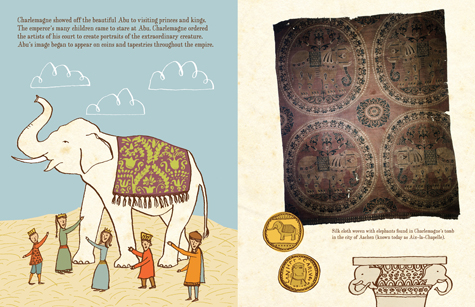
Abu even had his own keeper, a Jewish man named Isaac, and when they returned back to Europe both were invited to live in the palace.  “Once or twice a day Charlemagne would visit his immense guest.” Abu’s image was preserved in portraits and began to appear on coins and tapestries in the empire.  Even in Charlemagne’s tomb is a silk cloth woven with elephants.  Abu was taken into battle against the Danes and when he got old, Charlemagne had a house built for him and Isaac near a river.  In 810 Abu died and when Charlemagne learned of his death, “he wept.”

The story shows the amazing respect the two leaders had for one another, for animals, and the tolerance of people of different faiths.   At 40 pages it works for story time and for older students learning about the Middle Ages.  Obviously they would take away drastically  different points from the story, but both groups would enjoy it.  I learned a lot, so I recommend it to adults as well.  The pictures are beautiful water colors and pencil, supplemented with actual photos of artifacts, that all combine to make the story and book a wonderful addition to your library to be read and enjoyed again and again. elephant from baghdad 2


The Red Pencil by Andrea Davis Pinkney illustrated by Shane W. Evans

Standard

The Red Pencil.jpg

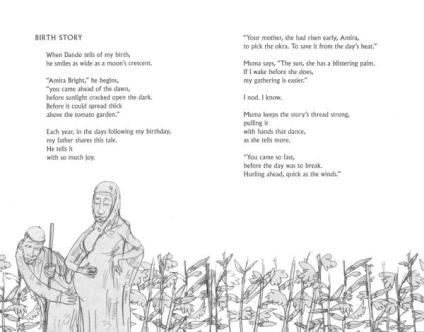
I didn’t realize the book was written in prose until I opened it up to read, and immediately taken-aback I rechecked the AR level and sure enough, this 309 page book that is written in prose and covers the genocide in Darfur, is written on a 4.2 level. And it is amazing. I forced myself to stop reading at one point so as to not rush the depth and soul of the simple words from being lost in haste.  It is truly, in my opinion, a beautifully remarkable feat to convey such horrific atrocities with such hope and integrity to young adults in a palatable and inspiring way.

“Allah is the light,” he says.

I ask,

“How do you find Allah’s light?”

Old Anwar says,

“Take the path that shines the brightest.”

SUMMARY:

Amira’s life on her family’s farm is by no means easy, but she has loving parents, a little sister, her beloved sheep, and a dream of going to school.  Her father advocates for her, but her mother, steeped in tradition, sees education only as a waste of time.  The illustrations and sparse words manage to convey fairly solid understanding of Amira’s life, optimism, and relationships with those closest to her.  Although warned of the dangers the Janjaweed could cause, Amira remains fairly unconcerned about the mounting political unrest around her, until it is too late.  When death and the destruction of her home force the surviving members of her family and neighbors to seek refuge in a camp many miles away, the reader sees how truly horrific her experiences have been.  She refuses to speak or rather cannot, when a chance encounter with an aid worker brings her the prospect of getting her voice back, through the empowerment of a red pencil.  With restored determination she convinces an elder neighbor to teach her, but it is not enough for Amira Bright.  Her sparrow needs to soar free.

WHY I LIKE IT:

You expect a book written in verse to have a lot of imagery and symbolism, and The Red Pencil does a good job of balancing the story and the description, to keep the book on track.  The linear story line remains focused on telling the story at hand, making it attainable for elementary and middle school children.  The Darfur conflict is complicated at best, and using verse to convey it from a young girl’s voice allows a lot of the politics and dirtiness of war to be side-stepped without dismissing it.  Amira’s optimism and hope is at times naive, but more as a reflection of her personality then out of ignorance. She sees things, and feels things, and must deal with things, no child should, but her spirit shines through and keeps the book from being depressing, while still being sad.

Today the red pencil does more

than beg for my hand.

It makes me a promise.

It tells me to try.

The characters are Muslim and they rely on Allah, and pray, yet Amira’s thirst for knowledge includes that of learning the Koran (Qur’an) as that knowledge too, has not been readily available to her  There is a lot to discuss in the book, both what is written and what the reader brings to it.  I look forward to teaching the book, and re-reading it once again to savor in the rich images.

Here,

Muma stoops.

Here,

she has nothing to reach for.

FLAGS:

Their is violence when the Janjaweed attack her family.  But I think it is conveyed in a manner suitable for 3rd grade and up.  It is not celebrated or glorified, it is traumatic and has repercussions that are respectfully conveyed.  There is also mention of a child bride, but not in so many words, that in all honesty I doubt most young readers will be as bothered by it as perhaps they should.

TOOLS FOR LEADING THE DISCUSSION:

There is a discussion guide in the back of the book along with an Author’s Note, Acknowledgements, Glossary/Pronunciation Guide, Character/Location Pronunciations, and Important Terms that Appear in the Book.

An Educators Guide: http://media.hdp.hbgusa.com/titles/assets/reading_group_guide/9780316247801/EG_9780316247801.pdf

A study guide and quiz: http://www.bookrags.com/studyguide-the-red-pencil/free-quiz.html#gsc.tab=0

The Red Pencil 1

Extra Credit by Andrew Clements

Standard
Extra Credit by Andrew Clements

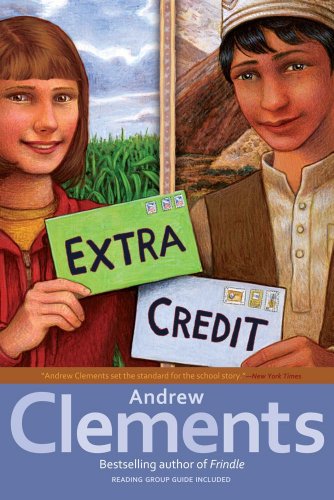
ImageHaving seen this book a million times, I never paid close enough attention to realize that the boy on the cover is an Afghani boy and that half of the story is told from an American girl’s perspective and half from young Sadeed.  My trusted librarian friend advised that the book is best taught through a discussion on what rules exist in Islam regarding gender roles, and why they exist.  And after reading it, I quite agree.  The story is very straight forward and predictable, and I really doubt most kids would find this to be Clements best work, however, I think if the students could be directed to critically evaluate WHY Sadeed’s community doesn’t want him communicating directly with American Abby, they might realize more about their parents own rules and reasoning, and be able to talk about them objectively.  The book is 183 pages and an Accelerated Reader Level 5.3.

SYNOPSIS:

Sixth grader Abby is in danger of being held back if she doesn’t keep up on her homework and do extra credit.  The extra credit assignment is to do a pen-pal project with a student in Afghanistan, unfortunately Sadeed, is the most qualified, but the village elders don’t think it appropriate for a girl and a boy to communicate.  As a result, Sadeed’s younger sister, Amira,  is selected to write back to Abby with Sadeed’s help.  Sadeed is annoyed by the process and begins writing to Abby independently, until events force him to reconsider.  The book is meant to show how people are universally the same, even when they seem so different.  Abby loves to rock climb and doesn’t like school, Sadeed loves school and has never thought to climb a mountain. Through their letters they realize they have more in common than originally thought.

WHY I LIKE IT:

The book discusses the Taliban and how fortunate Amira is to attend school.  It talks about Afghan culture in a fair light, and doesn’t paint all in Sadeed’s village with one stroke.  His parents, the village elders, the principal, all are seen as different individuals, with different thoughts and in a positive light.  If anything Abby’s world is seen as more bland and presented with a broad stroke of uncaring characters.  Sadeed and his family practice Islam and it shapes their moral conduct as well as their every day lives.  Islam is not what the book is about, but it does define the characters and their environment.  I like that it is age appropriate in dealing with complex topics of gender roles, and societal customs, I think our students can relate to both Abby and Sadeed (and even Amira), however I think that the characters would soon be forgotten.  While the book has a lot going for it, it seems to come up a little short.  If I do this as a book club discussion I would keep it 4th through 6th graders, I think the older students would be bored by it.  I think that the discussion would be more fruitful than the book alone.  InshaAllah, if one can get through the tediousness of, if Abby will get to go to seventh grade, and reach the top of the rock wall, there is a sweet story of building bridges and trying to see the world from other people’s perspectives; as well as opening the door to understanding why religiously and culturally our parents set up the boundaries that they do.

FLAGS:

The younger sister teases her older brother that he has a crush on her pen pal, and one could argue either way that he does, but, it is clean in terms of language, violence, and anything clearly objectionable.

TOOLS FOR LEADING THE DISCUSSION:

The discussion guide is found in the back of some editions, if not you can see it here:

http://books.simonandschuster.com/Extra-Credit/Andrew-Clements/9781416949312/reading_group_guide