Category Archives: Folktale

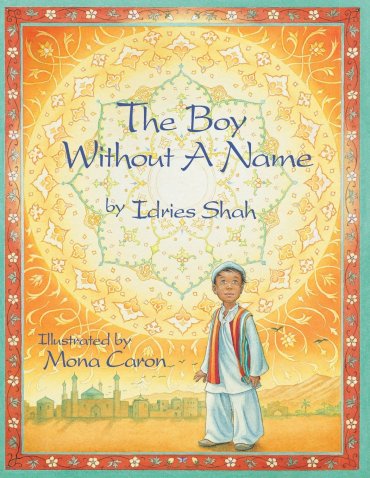
The Boy Without A Name by Idries Shah illustrated by Mona Caron

Standard
The Boy Without A Name by Idries Shah illustrated by Mona Caron

the-boy-without-a-name_orig.jpg

It is hard to know what a child would get out of this 32 page 3.2 AR level, but even if they just get lost in the pictures, and swept away by the idea of a boy searching for his name and a dream, I suppose there is value.  Some, ok most of Idries Shah’s, Sufi teaching stories are beyond my comprehension, but they are lyrical and often silly just the same. He has written over 30 and the libraries have quite a few, and people online seem to love so many of them, so perhaps I’m just not clever enough or philosophical enough to grasp them.  Which is neither here nor there, but maybe don’t buy one until you read one and see what you get out of them.  I keep checking them out and hoping I too will fall in love with one, I’ll keep you posted.

no name1

Before they can name their son an old man comes and tells the parents to not name him and to wait.  The boy grows up searching for a name, hoping someone has one he can have.  At one point he is made aware that he has nothing, even to trade for a name.  He responds that he has an old dream he no longer wants.  He and his friend Anwar then go to the wise man and he receives his name and a new dream.

The synopsis claims that patience and determination is learned, but I couldn’t get over the fact that the parents just didn’t name their child, and I never felt like I learned why he was such an important boy.

boywithoutname2

The pictures are wonderful with the scenic village’s tall minarets and colorful hijab clad women in the market place.  I particularly like the magic spilling out of the boxes in the old man’s house when the boys are finding names and dreams.  There is nothing overtly Islamic in the text, I’m not aware of how strong the Sufi origin is, not being Sufi, or having studied it.  But the illustrations definitely place the book in an Islamic cultural environment and the names reinforce this.


The Farmer’s Wife by Idries Shah illustrated by Rose Mary Santiago

Standard
The Farmer’s Wife by Idries Shah illustrated by Rose Mary Santiago

farmers-wife.jpg

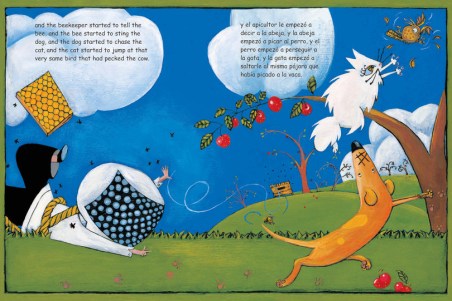
The book reads very much like the western children’s story/song, “I know an old lady who swallowed a fly,” but in this Sufi inspired repetitive story, An old Farmer’s wife can’t get an apple out of a hole.  

The silliness starts right away when she wants to get a bird to fly down the hole to get it for her.  When the bird says, “tweet,” which means no, she deems him naughty and then moves on to asking a cat to jump on the bird, to get the bird to get the apple.  The funny thing is the chain of events is funny and illogical at points. She wants water in a puddle, to put out a fire to burn a rope, the rope to tie up a bee keeper, and so on.  Luckily the wind finally blows the apple out of the hole and they all live happily ever after.

farmer2.jpg

The book supposedly is to teach patience, I am hoping to use it when I do a lesson on thinking outside the box and how sometimes that is great, but the trick is knowing when it might also be easier to reach down and pick up the apple.  

The book is AR 3.4 and 32 pages.  Many versions are dual languages.  The pictures are great with the abiya wearing woman and the chunky cartoonish side characters making the silly story fun to read a loud.  There is nothing “islamic” other than the illustrations showing the woman in hijab, and the author being a well known sufi writer who uses lessons from the Sufi tradition to teach lessons to children.

farmer1


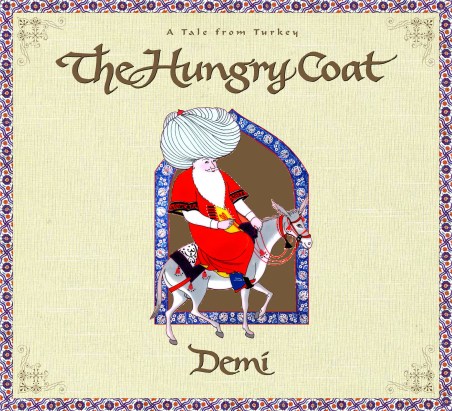
A Tale from Turkey The Hungry Coat by Demi

Standard
A Tale from Turkey The Hungry Coat by Demi

the hunger coat.jpg

It really bothered me that I didn’t love the version I read of  The Parrot and the Turkey about Nasreddin Hodja, especially after finding out how entwined he is in Turkish culture, and reading some of his tales online.  So, when I found that Demi had also rewritten and illustrated a tale from his collection I was anxious to check it out.

hungry-coat

The  Hungry Coat is a charming story and Demi does a great job of bringing it to life with her pictures and storytelling abilities.  The book is 36 pages and a 4.1 on AR.  The text isn’t overwhelming in volume, but to read it definitely requires a bit of an older child’s vocabulary.  Words like caravansary, hostel, banquet, frisky, and commotion are scattered through out.  However, to listen to the story and to understand the message Nasrettin Hoca (an alternate spelling) is conveying, is easily enjoyed by children four and up.  The story flows very smoothly and the catch line of “Eat, coat! Eat!” makes the story absolutely delightful.

hungry-coat1

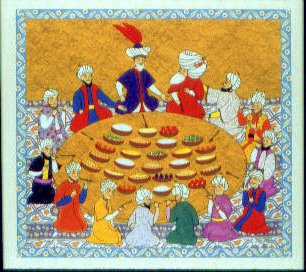
Nasrettin Hoca always keeps an apple in his pocket for any goats he might pass while he is out and about.  One day he helps round-up a goat that has gotten lost, and in all the commotion had become quite a mess and lost too much time to go home and change his clothes before heading to a friend’s house for dinner.  Deciding to go in his patchy, smelly clothes, Nasrettin soon finds that none at the dinner party will sit by him, or even sit facing him.  He slips out quietly from the gathering and has an idea.  He goes home and preens himself, and returns to the party where he is greeted with attention and kindness.  At dinner he begins placing the food in his coat, rather than eating it.  Each time he opens his coat he commands it to eat.  After he fills his coat he pats his belly to the bemusement of all around him as they ask him what he is doing.  He makes his point that when he came in his old coat he wasn’t fed, but when he came dressed so beautifully he was, and thus clearly the coat was invited to dinner, not him.  Everyone cheered and learned the lesson.

“A coat may be fine, but a coat does not make a man.”

The illustrations are rich and detailed, but I did find myself a little put off when Nasrettin seemed to go from looking like an old little man, to being very effeminate.  The inconsistency bothered me a bit, which surprised me for a Demi illustration.  Also, it is worth noting that there is mention of wine in the story, that many may find off for a children’s book, particularly one about Muslims (Nasrettin was an Imam and a Dervish, so he may have drunk, I’m just saying it surprised me).  The last two pages of the book are an afterword about Nasrettin Hoca in real life and the influence of his folk tales and lessons.