Category Archives: Elementary Fiction

Eid Kareem Ameer Saab By Fawzia Gilani-Williams

Standard

This book made me laugh. It is essentially the story of Scrooge in the Christmas Carol simplified for a younger audience and switched to an Islamic perspective.  Don’t get me wrong, despite its unoriginal foundation, it is a good story.

The main character is grouchy, wealthy Ameer Saab who we see in a typical day berating his servant Raheem, refusing to help a woman and her young baby, refusing to help the poor, and neglecting his Salah.  Meanwhile Raheem is scrounging up his money with his wife to provide food, while still managing to help a widow, and others.  That night Ameer Saab has three dreams, in the first he is reprimanded by his father, the second by his mother, and in the third his money and jewels strangle him.  He wakes up a changed man on Eid morning.

This book is great for 2nd through 4th graders, with colorful pictures and well spaced text, it invites rather than intimidates this age group.  The morals are also clear and influential as the reader can see clearly which side is more desirable to Allah swt.

There is a verse from the Quran explained, and there are a few Arabic words, nothing off-putting for a newly independent reader and at just 24 pages, I think most elementary age students will enjoy and benefit from the story.

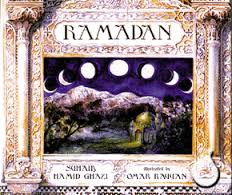
Ramadan By Suhaib Hamid Ghazi Illustrated by Omar Rayyan

Standard

ramadan

I remember when my parents first acquired this book (maybe they ordered it or it was a gift, I’m not sure), in 1996 there weren’t a lot of Islamic picture books to choose from and I took it to Sunday school to share with my students.  My preschool class loved the pictures, but the text was way over their heads and I had to summarize it to keep their focus.  Nearly twenty years later, there are a lot more options, yet the illustrations of this beautiful book are still mesmerizing to children, and the text is still too lengthy, factual, and complex to engage most children under 10 years old.

Hakeem, the main character in the book, explains not only Ramadan and fasting in detail, but also the basic tenets of Islam, words in Arabic with English descriptions, and makes numerous comparisons to other religions.  Everything is tastefully done, and probably was written to appeal to both Muslim and non Muslim children, allowing the reader to identify with Islam through whatever background they come from.  The result, unfortunately, results in a book with very little “story” and a whole lot of information.  It reads like a research paper on Islam, with a fictional boy thrown in to tell it in a simple way.  However, it isn’t a child’s voice speaking, and if the pictures weren’t so wonderfully done, no child would be at all tempted by the book.

That being said, if you have multiple aged children in your family, it works well to let the little ones look at the pictures while you “tell” them about Ramadan, and later letting the older ones build on their knowledge of Islam and Ramadan.  It doesn’t lend well to story time or larger groups in my experience, but could be a way to share information on Islam to curious adults, new converts, or young adults looking for the basics without being consumed by a text book.

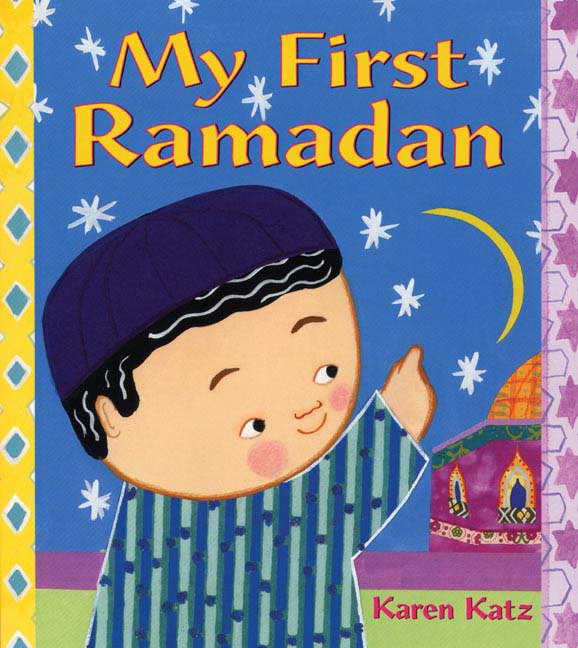
My First Ramadan by Karen Katz

Standard

my first ramadan
With Ramadan here my goal is to round up all my Ramadan and Eid picutre books to share (and hopefully review). Unfortunately school is out for the summer, so it will be mostly just sharing with my own children and nieces and nephews.

Karen Katz, a popular children’s author wrote and illustrated a children’s book about Ramadan and Muslims called My First Ramadan. It is an AR 2.8 and the pictures are done in her signature style, which the kids will recognize and love. Told from a little boy’s perspective he explains Ramadan, Islamic traditions, basics of Islam (Quran, Prophet Muhammad (peace and blessings be upon him)) and some of the five pillars. Words such as iftat, suhoor, fajr, maghrib, are introduced, explained and even have a pronunciation guide in parenthesis.

A few things that I discussed with my kids while reading are that in the picture talking about Prophet Muhammad (peace and blessings be upon him) teaching his followers to break their fast with a date and water, that RasulAllah is NOT pictured and why we don’t picture him. I also explained that each family has traditions, and the one in the book sits on the floor to eat. Islamically it isn’t required. We also talked about why in the book the men and women are in different rooms when they pray and in some Masjids they are in the same room, the men in front and the women in back.

The book mentions and illustrates how happy Ramadan and Eid are, and how Muslims come from all over the world. In the pictures some woman cover, some don’t, but we are all family. All in all a cute book that introduce and reinforces Ramadan.

The Hundredth Name By Shulamith Levey Oppenheim

Standard

hundredth

The Hundredth Name is a heartwarming story of a boy named Salah, his father, and his camel named Qadiim, Ancient One.  Salah is concerned that his best friend Qadiim is sad, and this in turn makes Salah said.  As Salah’s father gently and patiently teaches Salah about the power of prayer, the mercy of Allah and how we only know 99 names of Allah, the hundredth name is not known to us, Salah finds a way to make Qadiim happy.  Through beautiful pictures and prose like paragraphs, the reader is inspired to trust Allah with all matters, big and small.

The book has 32 pages and is an Accelerated Reader level 3.7.  I think Kindergarten would enjoy this book during story time, but the younger ones, Daycare through Pre-k,  may not truly understand the beauty and the message.

My Father’s Shop By Satomi Ichikawa

Standard

Image

What a surprisingly delightful book about a Moroccan boy named Mustafa in his father’s rug shop.  Helping his father, Mustafa finds a beautiful carpet with a hole in it and asks his father if he can have it.  His father agrees if in turn he promises to work on phrases in a variety of languages to help them sell carpets to tourists.  The boy agrees, but doesn’t put much effort in until in a moment of fun, he puts the carpet over his head, peeking through the hole, and runs out into the bazaar.  A rooster begins following him and as the tourists gather around, Mustafa, and the reader learn what a rooster says in five languages.  In Morocco:Kho Kho Hou Houuu!
In France: Co-co-ri-co! In Spain: Qui-qui-ri-qui! In England: Cock-a-doodle-doo! In Japan: Koke-ko-kooo!

The pictures really bring the story to life and connect the story to the reader.  I look forward to reading this book aloud during story time as I think the kids will see themselves in the Muslim characters in the bazaar, and see the different cultures all in one place just as they do in their classes.  At 32 pages the book is simple and memorable with large print and not too many words on the page.  It has an AR level of 2.2 and I think the kids will laugh and contribute to the sounds roosters make.  The story is completely clean, enjoyable, and memorable.

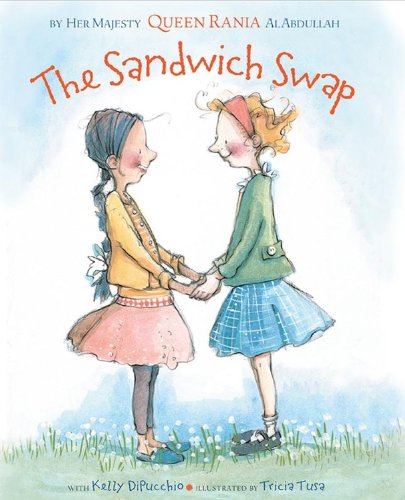
The Sandwich Swap by Queen Rania Al Abdullah

Standard

Image

I stumbled upon this book at a used book shop and my own children loved it so much (ages 7,4,3) that I took it to school and read it to the Kindergarten Class.  The KG class loved it, the students eyes lit up when I read the words “hummus sandwich” and had to be settled down when they learned one of the characters is named Salma.  Even the youngest of our children, subhanAllah know what a treat it is to see a character they can relate to religiously and culturally in a beautifully illustrated book.

The Sandwich Swap by Her Majesty Queen Rania (the girls were excited just knowing a REAL queen wrote the book), is a sweet story of two best friends who are put off by each others “weird” lunches, peanut butter and jelly and hummus and pita.  The situation escalates until the whole school is pointing out differences between students and the foods they eat and climaxes in a food fight.  Salma and Lily realize how silly it all is, sample each others lunches and then work to bring the entire school back together.  

A good book to talk about differences, and similarities, friends and food.  The book appeals to students of all ages with an Accelerated Reader level of 2.9, I think most preschool to Third grade students would laugh, and smile throughout the entire story.

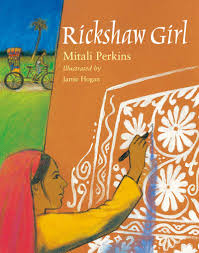
Rickshaw Girl by Mitali Perkins

Standard

Image

The book Rickshaw Girl by Mitali Perkins was recommended to me by the same person that suggested Overboard, (thanks Cheryl) as it is a rare book that appeals to the often difficult to find 2nd to 4th grade demographic.  The book is 91 pages, with large drawings and a fairly large font.  I read it in about 30 minutes and I’m sure most students, not slowed down by the names, could easily read it in a few hours.  It is that engaging and vivid that I think most students, boys included, would have a hard time putting it down.  The AR level is 4.3, but I think the gender issues would be relate-able in an Islamic School setting to advanced second graders.  I am considering obtaining a few more copies and letting the younger students that really want to be in the Book Club read this book and give it a try; or reading the book aloud to the students and then discussing it with them, will talk to some teachers and post back what I opt to do, inshaAllah.

SYNOPSIS:

Set in Bangladesh, Rickshaw Girl is a sweet story about 10-year-old Naima, who is smart and caring, and at that critical age where she can no longer play freely with her best friend, because he is a boy, she must start helping her mother in tending to the house, and because of financial restraints can no longer continue her school education.  Frustrated by the fact that as a girl and she cannot financially help her father, as a son would be able to do, she makes a poor decision that causes the situation to get worse (don’t want to spoil the book by disclosing what she does). Her personality and inner strength, however, push her on a path to correct her mistake and help her family, proving girls can definitely rise above restraint and succeed in following their dreams.

WHY I LIKE IT:

One could/would assume (dangerous I know) that the characters are Muslim, it is never stated, never implied, never brought up.  In the pictures the female characters have a scarf draped over their hair, but in that part of the world, most every woman would.  Same goes for the gender issues.  That being said, I think it would lend itself very easily to a discussion of what most Muslim girls experience in general terms of being slowly discouraged from playing with boys, encouraged to start helping in the kitchen, etc.  I love that the story is fast paced and that you truly cringe at Naima’s actions, and cheer for her to try and fix her error.  Her family situation is also very soothing.  Her parents are strong and loving and kind, and I think how most 10 year old children see their families.

Flags:  None, clean

TOOLS FOR LEADING THE DISCUSSION:

The author’s own page is helpful in getting the ball rolling, there is also information in the back of the book: glossary, author’s note about microfinance and how to wear a saree.

Click to access RickshawGirlDiscussionGuide.pdf