Tag Archives: standing up

Hope Ablaze by Sarah Mughal Rana

Standard
Hope Ablaze by Sarah Mughal Rana

This young adult book is an intense raw unflinching read, containing  incarceration, assault, politics, Islamophobia, immigrant pressure, and loss throughout the 384 pages that mix poetry and traditional writing.  At times the book is incredibly hard to put down as the commentary on two party politics and Muslims in America is articulated in a way that transcends the fictional constrains and affirms reality.  But unfortunately, it took me a long time to complete the book, because when I did put it down, I didn’t feel that relentless urge to pick it up and see what happens next.  I had been alerted to the fact that there were elements of magical realism, but even with that knowledge, I still felt it misplaced, and truthfully, unnecessary.  The pacing was inconsistent, and many points unnecessarily forced.  It often felt the author was simply trying too hard to tell the story and make sure the reader got all the messages intended.  As a result many characters are flat, many plot holes exist, and the reader is left wishing things were done just a little bit different to make the book what it could have been, not what it is.  I know it is a debut, so I’m not going to be overly detailed in my harshness, I am fairly positive I will read anything this author writes down the road, I took pictures and shared passages that I loved on my socials.  The book is good, it just really could have been great.

SYNOPSIS:

Nida is a poet, her uncle is a poet, and her uncle is in prison.  When Nida is frisked, her hijab removed by a political candidate’s team as she makes salat in a public park, Nida is forced to find her words, her voice, and her place in an unkind Islamophobic world.  High school friendships, immigrant Muslim community pressures and idiosyncrasies persist for Nida as she navigates media manipulation, injustice, slander, and political talking points.  Life was already complicated with her father’s departure, her maternal uncle’s wrongful incarceration, and the goats that her mother brings home to sacrifice, but with the support of the Poet’s Block, her Muslim community, family, and the thread tied to her family through generations, she will find she isn’t alone, and she has support, she just has to take a stand.

WHY I LIKE IT:

I love how much mirrors contemporary reality, the MIST competition, the politics, the media, the dirtiness of it all. I also like that it has a fair amount of humor, the Islamic accuracy, friends getting called out for boys and girls texting each other.  Overall though, it just felt so forced. I think some subtly and nuance and undercurrents would have given the reader the ability to connect the dots for themselves, so the book would have lingered and taken up space long after the last page was read.  It is hard to write a book about how great a writer is, how powerful poems are, so at times it really felt spoon fed that this is powerful, here read it, see it was powerful.  Additionally, I think when the author did try for subtlety, it just came across as lacking.  I still don’t fully understand any of the side characters, their relationships, or their purpose.  From the betrayal of a school friend, to the new friend from MIST, to the little brother, to the friend and his uncle who is imprisoned, there ultimately lacked a lot of emotional heart for minor characters, who remained stagnant, while passionately emphasizing issues at their expense.

The OWN voice Islamic rep is so spot on even if the evil eye passages seemed amplified and repetitive. Islam is centered, it is unapologetic, it is the characters identity, comfort, and soul.   Only one point really stood out as erroneous, but I read a digital ARC so it could have been fixed or it could have been a spacing issue since it was in a poem, but it has sajood in janazah, and I’m really hoping the final book will not have it wrong, as there is no sajood in janazah.

FLAGS:

Assault, frisking, incarceration, death, profanity (not a lot, damn, hell, shit), Islamophobia, racism, systemic abuse, lying, talk of terrorism, stereotypes, gaslighting.

TOOLS FOR LEADING THE DISCUSSION:
I’m on the fence about using this book for a book club read.  I love the Pakistani culture, the Islam, the contemporary relevance, and the political commentary.  I think it would have actually more success in a guided or required reading situation with teens than it would as a pleasure read.  Undoubtedly I will order a copy to put on my library shelf, but I might test it out a bit on a few readers to see how their thoughts before I present it as a book club selection or not.

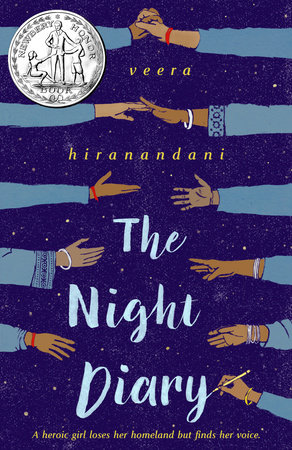
The Night Diary by Veera Hiranandani

Standard
The Night Diary by Veera Hiranandani

night diary

I was curious to see how partition would be presented in this book by an Indian Hindu author featuring characters who are half Hindu and half Muslim relocating to Hindu India.  Told in journal entries written by 12 year old Nisha to her deceased Muslim mother, the 264 page AR 4.5 book is wonderfully done, extremely compelling, and about so much more than the politics that birthed India and Pakistan.

SYNOPSIS:

Nisha and her twin brother Amil are opposites, yet they complete each other and care for each other in such a tangible and heart swelling way, that you can’t cheer for one while not rooting for the other one to find success and their place in the world as well.  As the twins turn 12 and Nisha is gifted with a journal from the families beloved cook Kazi, India and Pakistan too are about to come to fruition and Nisha’s journal entries detail her understanding of the larger events around her as well as her own struggles to come in to her own.

For Nisha words do not come easily.  She excels at school and loves to cook, but talking to people, or making friends eludes her and her longing for her deceased mother, make her a quiet reflective child.   She observes and  takes in so much around her, internalizes it, ruminates on it, and pieces it back together in a gifted way when she writes, that reading her entries, and the voice the author creates for her, is really amazing and fluid.  You feel like you really know Nisha and what makes her tick, what she fears, and how she thinks, you also get emotional attached to her and her world and find yourself surprised at how invested you are in not only her family’s successful migration across the new border, but also in her finding her voice and the confidence to use it.

Amil’s voice comes through Nisha, but her love for him and the way his strengths are her weaknesses and vice versa allows insight into the other family dynamics and attitudes to the two children.  Amil is an amazing artist, that suffers from dyslexia and does poorly in school.  He is weak and wiry, but fast, and he can talk and charm and ask all the questions that Nisha wants asked but can’t find the words for.  He and their physician father are rarely on good terms, as he isn’t the ideal strong boy with a medical degree in his future.

When it is decided that the family must leave their city where Muslims and Hindus and Sikhs live together and journey into Hindu India, the twins, their father, and their father’s mother, Dadi, must rely on each other to survive the riots and violence of the mass migration.  Nisha must also survive the understanding that with a Hindu father and Muslim mother there is so much about her own place in the world she doesn’t understand, and thus the journey is both an internal and external one, that will change Nisha forever.

WHY I LIKE IT:

I love that the protagonists voice is so steady and believable.  I truly fell in love with Nisha and felt her pain, happiness, anguish and overall got emotional for her, it was a rollercoaster.  The author does an amazing job of painting the politics of Jinnah, Nehru, Gandhi and Mountbatten in broad strokes, but believable ones to the understanding of a 12 year old.  She sees that one India held people of all faiths and that this breaking up of everything is leading to violence, upheaval, and horrors previously unimaginable.  She doesn’t understand why people had issues with her mother being of one faith and her father another, she loves her Muslim cook and loves listening to him pray five times a day as her paternal grandmother sings Hindu prayers in the other room.  She is both Hindu and Muslim and doesn’t see the contradiction within herself, suspending the reader’s own opinions on partition (if they have them), because how she sees it, does make sense for the story’s narrative.  The author takes Gandhi’s side of non violence and staying together, but balances very well and very intentionally that atrocities and humanity was seen from people of various faiths and political persuasions.  The role of British colonization and freedom from it, is slightly glossed over to the point of disservice, but again, being the target age of the reader and the age of the characters, I’m willing to over look it.  Families with Indian and Pakistani heritage will want to take the lacking information and help their children to fill in the blanks.

I love that the backdrop is the action of the story, but the relationship between the characters is truly the heart.  A lot of growth and compassion is conveyed very succinctly and powerfully.  Nisha wants so desperately to speak, but can’t, and her internal struggle and the pain she feels when she can’t speak up to help and participate in the world around her is gut wrenching.  As she confides in her diary, you realize that kids understand so much more than we adults often give them credit for.  The lesson is not lost on me.  I initially thought a book steeped in subcontinent history, with religious conflict and foreign words, wouldn’t appeal to a western elementary aged readers, after reading it, however, I now think this heartwarming story should be thrust upon them all.

FLAGS:

There is violence and death.  Not sensationalized, but detailed enough to set the tone of how serious the journeys were between the two countries when British rule stopped  There is some bullying and mention of the father smoking socially with friends.

TOOLS FOR LEADING THE DISCUSSION:

There is an Author’s Note, and a glossary at the back, and the inside covers have maps showing the journey the characters take.  I would absolutely do this as a Book Club selection for upper elementary, and will consider it even for middle school.  A lot of tools for teaching the book are available online, here are just a few:

Educator’s Guide: https://www.penguin.com/wp-content/uploads/2018/02/The-Night-Diary_Educator-GuideWEB.pdf

Children’s Discussion Questions: https://www.readbrightly.com/brightlys-book-club-for-kids-the-night-diary/

Classroom Bookshelf: http://www.theclassroombookshelf.com/2018/06/the-night-diary/