Tag Archives: Muslim Character

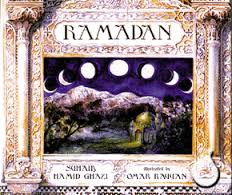
Ramadan By Suhaib Hamid Ghazi Illustrated by Omar Rayyan

Standard

ramadan

I remember when my parents first acquired this book (maybe they ordered it or it was a gift, I’m not sure), in 1996 there weren’t a lot of Islamic picture books to choose from and I took it to Sunday school to share with my students.  My preschool class loved the pictures, but the text was way over their heads and I had to summarize it to keep their focus.  Nearly twenty years later, there are a lot more options, yet the illustrations of this beautiful book are still mesmerizing to children, and the text is still too lengthy, factual, and complex to engage most children under 10 years old.

Hakeem, the main character in the book, explains not only Ramadan and fasting in detail, but also the basic tenets of Islam, words in Arabic with English descriptions, and makes numerous comparisons to other religions.  Everything is tastefully done, and probably was written to appeal to both Muslim and non Muslim children, allowing the reader to identify with Islam through whatever background they come from.  The result, unfortunately, results in a book with very little “story” and a whole lot of information.  It reads like a research paper on Islam, with a fictional boy thrown in to tell it in a simple way.  However, it isn’t a child’s voice speaking, and if the pictures weren’t so wonderfully done, no child would be at all tempted by the book.

That being said, if you have multiple aged children in your family, it works well to let the little ones look at the pictures while you “tell” them about Ramadan, and later letting the older ones build on their knowledge of Islam and Ramadan.  It doesn’t lend well to story time or larger groups in my experience, but could be a way to share information on Islam to curious adults, new converts, or young adults looking for the basics without being consumed by a text book.

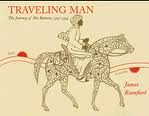
Traveling Man, The Journey of Ibn Battuta, 1325-1354 By James Rumford

Standard

travelingThis is a fascinating book about 14th century explorer Ibn Battuta. Born in Morrocco, Ibn Battuta, travelled to China, Russia, through Africa, totaling some 75,000 miles in all and returning to document his travels and lessons. A devout Muslim he performed Hajj and saw the beauty of Islam in much of his travels. The book is beautifully done, as the words flow around the pages in both English and Arabic calligraphy. The story is simple enough to be read aloud in a Social Studies class or poured over independently time and again. It has an AR level of 4.0 and I think if it correlates with a lesson about Ibn Battuta, or is read in conjunction with lessons of Marco Polo and even Christopher Columbus, the book will be well received. I can’t forsee anyone younger than second grade truly understanding his journey, and how remarkable it was then, and still is today. This non-fiction book is clean and imaginative in summarizing his travels. Adults as well as children will spend time analiyzing the pictures and maps included in this 34 page book.

I am Malala By Malala Yousafzai and Christina Lamb

Standard

malala pic big

Naturally we all have heard Malala’s story and while some are inspired by it, some seem to have major hostility toward her and her approach.  Chosing to take her at face value and be inspired by her, I was generally looking forward to reading her story before I ever entertained thoughts of using it as a teaching tool in a school.  It is an AR reading level of 7.1 so once I obtained the book I rushed to read it before the end of the school year to see if perhaps our 7th and 8th grade students could read it and leave for the summer realizing the blessing that an education can be from someone who has had to risk it all, just for the chance to learn.  However upon completion I think that the dates, and history of Pakistan would ultimately drag the book on for the majority of Middle-Schoolers and her message and inspiration would be lost.  For adults looking for a book club book however, I would highly recommend it.  As a half Pakistani-American growing up spending my summers in Pakistan, I could relate and recall so much of what she wrote about.  I think most adults of any background would similarly be able to recall major news events, and be able to follow along.  I think anyone younger would find it incredibly difficult and possibly dull to get through.  I think that students would benefit from learning about her story and then only reading excerpts from the book.  There are some very moving sections that I think the average middle schooler would be impacted by, and the included pictures amongst the 327 pages would give them a glimpse into her world.   I on the other hand, couldn’t put it down, the book reads very quickly and bounces around all over the place, which actually didn’t bother me, I enjoyed her descriptions of her town and family and friends.  While Malala wrote it with an author, I think the tone is very much that of a young girl and thus the style works for me.  Political views aside the book made me smile, made me cry, and makes me feel better off having read it.

SYNOPSIS:

Malala is a Pashtun girl in the Swat Valley in Pakistan.  In a culture that keeps females behind doors and cloth, her father is the anomaly and encourages her to be educated, free, and vocal.  As 9/11 occurs, the Taliban sets in, the west wages war on Afghanistan, Osama bin Laden is killed, governments change in Pakistan, floods and earthquakes destroy the land, Malala and her family struggle to survive, improve their community, and advocate for the right of women to be educated.  All this climaxes in the Taliban boarding her school van and shooting her in the face at point-blank range.  She is then rushed to various hospitals before being taken to Birmingham, England. 

WHY I LIKE IT: 

It gives hope and shows that there are people making a differences and despite the risks, do want to change things in the world.  It is a great example that one person can make a difference.  Her family and her are active Muslims, that reflect on the Quran and try to understand where the Taliban is wrong in their interpretation.  Religion is a defining factor in every aspect from personal to culturally to government, and presents just how different each person seems to manipulate religion to their own benefit.   It might seem odd for some that she is writing this memoir of sorts when she has barely lived a long enough life to reflect back upon.  It also is perhaps overly optimistic as the story is ongoing, what she will do now is unanswered because it is not yet been given a chance to unfold.  I think the story is strong enough to cut through the criticism, and can be very powerful from both a child’s point of view, and from her parents.  Most readers if they can get through the intermingling of her story and that of her country will be affected by her plight.

FLAGS:

Violence, but done in a newscast style, not overly sensationalized, but details are given.


The Meat Eating Vegetarian by Caroline Maryam Ward

Standard

ImageA quick read even for the 2nd through 4th grade age group with 44 pages, lots of pictures, and generous spacing.  I  feel it could have been done as a picture book, but for the age group and the fact that it is hardback, the book does sit nice on a shelf and encourage a budding reader to open it up and not feel intimidated.  The book is written in British English, so my daughter had a few questions regarding terminology and spelling, which alhumdulillah, gave us a chance to talk about a different culture (albeit a different one than the book was targeting).

SYNOPSIS:

British born of Pakistani heritage, Tasneem starts a new school in the fall, she quickly becomes friends with Yvonne and Lisa.  After a play-date at Tasneem’s house however, Lisa and Yvonne feel Tasneem has been lying to them about wearing a scarf and eating vegetarian lunches every day in the cafeteria.  Their teacher helps facilitate a dialog and the girls learn about zabiha, rules of hijab, and the importance of communication in a friendship.

WHY I LIKE IT:  

The book is not preachy, Tasneem is Muslim, the other girls are very nice, it is a simple story that helps a Muslim reader see that one can be true to themselves in any environment and succeed.  In terms of identity building it is great to see mixed characters with open minds, but at the same time not present it as trouble free, which is something it often is not.  The only hesitation in recommending this book that I can foresee, is within the Muslim community there is division on Zabiha/Halal.  Tasneem does tell her friends that because she is still young, the hijab is not mandated for her, but the meat issue will either be amazingly relative to a student, or incredibly off putting, depending on their background.

FLAGS: none, completely clean, Alhumdulillah


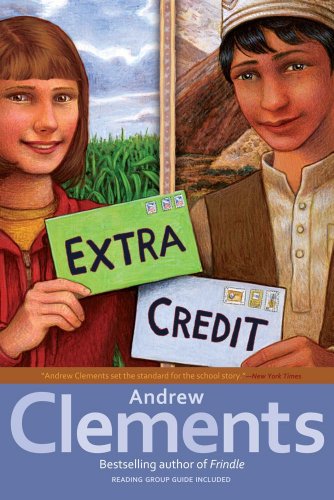
Extra Credit by Andrew Clements

Standard
Extra Credit by Andrew Clements

ImageHaving seen this book a million times, I never paid close enough attention to realize that the boy on the cover is an Afghani boy and that half of the story is told from an American girl’s perspective and half from young Sadeed.  My trusted librarian friend advised that the book is best taught through a discussion on what rules exist in Islam regarding gender roles, and why they exist.  And after reading it, I quite agree.  The story is very straight forward and predictable, and I really doubt most kids would find this to be Clements best work, however, I think if the students could be directed to critically evaluate WHY Sadeed’s community doesn’t want him communicating directly with American Abby, they might realize more about their parents own rules and reasoning, and be able to talk about them objectively.  The book is 183 pages and an Accelerated Reader Level 5.3.

SYNOPSIS:

Sixth grader Abby is in danger of being held back if she doesn’t keep up on her homework and do extra credit.  The extra credit assignment is to do a pen-pal project with a student in Afghanistan, unfortunately Sadeed, is the most qualified, but the village elders don’t think it appropriate for a girl and a boy to communicate.  As a result, Sadeed’s younger sister, Amira,  is selected to write back to Abby with Sadeed’s help.  Sadeed is annoyed by the process and begins writing to Abby independently, until events force him to reconsider.  The book is meant to show how people are universally the same, even when they seem so different.  Abby loves to rock climb and doesn’t like school, Sadeed loves school and has never thought to climb a mountain. Through their letters they realize they have more in common than originally thought.

WHY I LIKE IT:

The book discusses the Taliban and how fortunate Amira is to attend school.  It talks about Afghan culture in a fair light, and doesn’t paint all in Sadeed’s village with one stroke.  His parents, the village elders, the principal, all are seen as different individuals, with different thoughts and in a positive light.  If anything Abby’s world is seen as more bland and presented with a broad stroke of uncaring characters.  Sadeed and his family practice Islam and it shapes their moral conduct as well as their every day lives.  Islam is not what the book is about, but it does define the characters and their environment.  I like that it is age appropriate in dealing with complex topics of gender roles, and societal customs, I think our students can relate to both Abby and Sadeed (and even Amira), however I think that the characters would soon be forgotten.  While the book has a lot going for it, it seems to come up a little short.  If I do this as a book club discussion I would keep it 4th through 6th graders, I think the older students would be bored by it.  I think that the discussion would be more fruitful than the book alone.  InshaAllah, if one can get through the tediousness of, if Abby will get to go to seventh grade, and reach the top of the rock wall, there is a sweet story of building bridges and trying to see the world from other people’s perspectives; as well as opening the door to understanding why religiously and culturally our parents set up the boundaries that they do.

FLAGS:

The younger sister teases her older brother that he has a crush on her pen pal, and one could argue either way that he does, but, it is clean in terms of language, violence, and anything clearly objectionable.

TOOLS FOR LEADING THE DISCUSSION:

The discussion guide is found in the back of some editions, if not you can see it here:

http://books.simonandschuster.com/Extra-Credit/Andrew-Clements/9781416949312/reading_group_guide

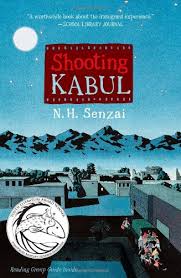
Shooting Kabul By N.H. Senzai

Standard

ImageShooting Kabul is another book that I just re-read to see if it would be a good fit for our 5th – 8th grade Book Club, and I think it will be a perfect fit, so much in fact that i just ordered enough copies to use for our next selection, inshaAllah.  It has an AR level of 5.4, perfect for our age group, and depending on the copy and extra glossary, book discussion and extra pages, about 262 pages of story. I haven’t decided if I will have everyone read it, or divide the group on gender lines, have the boys read Shooting Kabul, and the girls read When Wings Expand.  Senzai’s book is definitely not a “boy” book, but knowing the boys in the school, and how tender-hearted they all seem to be to their little sisters and the preschool students, I may divide the genders so they feel a bit more free in discussing.  Not sure yet, will keep you posted.

SYNOPSIS:

Told from the 11-year-old perspective of Fadi, the reader is taken on an adventure that is both heart-wrenching and plausible.  Fadi’s family makes the decision to leave Afghanistan as the Taliban’s power grows and threatens the family.  In their covert escape, Fadi’s six-year-old sister Mariam is left behind and the family must continue on to America, obviously all completely destroyed by their loss.  Once in California the family struggles with fitting in, making their way, and living through September 11th and the repercussions of the aftermath on Muslims.  Fadi turns to photography and finds a niche, as well as hope that perhaps he can win the grand prize in a photography contest that will take him to India, that much closer to where his sister might be found.

WHY I LIKE IT:

The book, while political does not make it a black and white issue, like some YA novels dealing with Afghanistan.  Similarly while September 11, is a huge incident in the book, it is presented from the perspective of how it makes Fadi feel, and the bullying that comes with it, again keeping the terror a bit at arms length and consumable by a younger audience.  Being that the book is loosely based on the Author’s husband, and his family’s escape I think it would be permissible to say that the account and portrayal of life in Kabul and immigrating to America is realistic.  As a result, the authenticity of Islam is also kept.  The characters are Muslim and it defines them, it gives the character’s depth, but is not forced upon the reader.  Fadi goes to Jummah, he ponders points about the khutbah (sermon), he and his father discuss how the Taliban uses Islam to their advantage, not in the way the Qur’an and Hadith present it.  The reader, either Muslim or non, I doubt would be overwhelmed by the religious presentation, it simply shows that aspect of the character.  Fadi is not questioning his faith, nor is it being forced on him, it is simply who he is, and something that defines him, something I think will be identifiable to my students and allow them to imagine what they would do if they were in Fadi’s place.

In a few parts the story gets a bit slow, but I think if the connection is made, the students will not be bogged down by his internal struggles to tell everyone that he blames himself for the loss of his sister.  And if they do, they are short lived pauses and the book flows fairly smooth and quick as a whole.

FLAGS:

The book is clean of language, boy girl issues, violence and content.

TOOLS FOR LEADING THE DISCUSSION:

The author’s website is helpful

Home

If your copy doesn’t have the readers guide it can be found here:

Click to access SHOOTING%20KABUL_reading%20guide.pdf

I liked these interviews with the author:

http://www.mitaliblog.com/2010/06/chat-with-n-h-senzai-author-of-shooting.html

http://carpekeyboard.blogspot.com/2010/10/talking-with-n-h-senzai-author-of.html


UPDATE:

Yes that is the author down in the comments section, commenting, amazing I know. And get this I emailed her AND she responded, amazing indeed, subhanAllah, so here is what I wrote her:

Hi, wow, I’m still a kid in the sense that I feel author’s aren’t real people, so to get a comment from you, blows me away 🙂 thank you.  I will absolutely let you know how it goes, if you get a few minutes, I’ve read a number of your interviews, but was wondering why you chose to use your initials rather than your first name? And also, since I’m sure there will be a cynic or two in the group, as a writer/ storyteller, did you ever consider not having Mariam found and returned? If so why did you go with the “happy ending.”  Love your book, need to read Saving Kabul Corner.
Thank you so much,
and her reply:
no need to feel like a little kid! but i know what you mean… i still feel like that when i meet authors i love and respect!  regarding the initials — it would make a foreign name longer and harder to remember — plus since its a boy book I wanted to have an ambiguous authorship.  since its a kids book it “had” to have a positive ending, thus mariam was found…. but when i talk to kids i tell them that thousands of children are not found in war/conflict.

hope you guys have fun reading it!

best,
Naheed

N.H. Senzai
www.nhsenzai.com

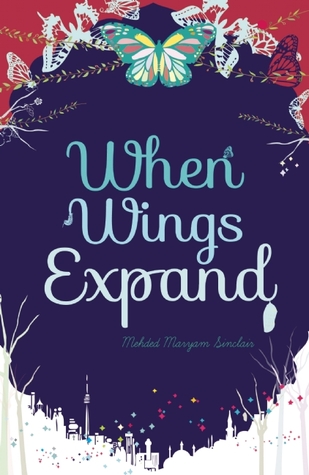
When Wings Expand By Mehded Maryam Sinclair

Standard

Image

When Wings Expand, by Mehded Maryam Sinclair, was loaned to me by a friend who knew I was looking for books that might appeal, positively to 7th and 8th grade Muslim girls.  While this book would definitely appeal to that demographic it would not be limited to such a small population.  I plan to open it up to all the girls 5th – 8th grade for the Book Club, and recommend it to parents with older daughters to read together.  While the book is an easy read in terms of grammar, vocabulary and style, (150 pages written as journal entries), the content is emotional and religious.  The book is not AR, so I will have to make a quiz, but I would assume it would be about a 5th grade reading level.

SYNOPSIS:

Canadian teenager Nur, chronicles her mother’s onset of cancer, her death, and life after the loss of her mother through journal entries.  Using simple symbolism of a butterfly’s life cycle, Sinclair shows how Nur must not only grieve and accept her mother’s death, but also reaffirm her faith and trust in Allah (swt) and His plan.

WHY I LIKE IT:

I love that at it’s center the book is about two relationships; a young girl and Allah (swt), as well as a young girl and her Mother, both dear to her heart, neither tangible.  Any one with a heart can imagine the immense pain in losing one’s mother.  Teenage girls particularly need to be reminded that while they may constantly butt heads with their mothers, to lose their mom would be devastating; the book makes that point abundantly clear.  Nur and her mother seem to have a “perfect” relationship, at least in that Sinclair doesn’t detail any strain between the two of them, but I think the readers can supply their own baggage and imagination and still be able to connect with the character.  I like that Nur’s mom is Turkish and that her Father is a convert, I think that so many youth today are from mixed backgrounds and the juggling and sorting of customs is something they can relate to as well.  The book is clean of boy/girl issues, language, violence etc.  In some areas it is a bit too “perfect” so to speak, in how understanding Nur’s father always is with her and her brother and how readily their uncle swoops in to take them hiking or on a picnic, but it some ways the simplicity of it all is also it’s charm.  As the book progresses Nur, must help a cancer patient with some of her own faltering faith issues, and with strong Quranic examples, seerah examples, prayer, and love, the reader is able to reflect on the message, rather then getting caught up in some fast passed action sequence.  I think the book has a place, and I hope that it reminds the girls how short this life is, the value of their mothers,  the pain associated with loss, strength of family, and Allah’s mercy.

TOOLS FOR LEADING THE DISCUSSION:

A box of tissues

Honestly because the cycle from sadness, to anger to acceptance to peace is fairly universal, I plan to simply let the students talk about the book, to see it through their perspective.  I don’t think much prodding will be needed.

Overboard By Elizabeth Fama

Standard

BismillahirRahman ir Raheem
overboard

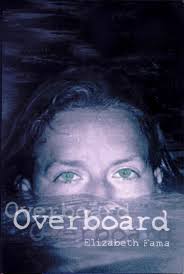
I decide to start off the Book Club with a book that is completely clean of any boy girl issues, preachy-ness, excessive violence, crude language, etc.  My good friend and a former Islamic School Librarian in Rhode Island recommend Overboard, by Elizabeth Fama, for its quick moving plot, and easy reading style.  The book is only 158 pages and I read it in about 2 hours.   The book additionally appealed to me because it is an Accelerated Reader level 5.1, allowing me to open up the Book Club to grades 5-8th to see where the most interest is, and helping establish the Book Club participation protocol;  To gain access to the lunchtime discussion students are required to earn a passing score on an AR Book Test.  The book is out of print (according to the Author, more on that later), but through ebay and a local used book store I was able to acquire eight copies of the book.

SYNOPSIS:

Fourteen-year-old Emily boards an over-crowded ferry in Sumatra. When the boat sinks, she’s trapped by hundreds of panicked people. She finds Isman, a terrified young Muslim boy, floating in a life vest. Together, with Emily’s physical strength and Isman’s quiet faith, they swim for their lives.

WHY I LIKE IT:

The book is not in your face about Islam, as the main character is not Muslim.  Emily is from Boston who has moved to Indonesia with her physician parents, and is miserable.  She does not relate to the people, does not try to even, and wants nothing more than to go home.  Knowing her uncle is on a nearby island she runs away from her parents and boards a ferry to search out her uncle and hopefully, a way home to Boston.  The ferry sinks and she must not only find a way to survive, but is constantly forced to make choices that define and often surprise her as well as the reader.  In the middle of the ocean with people fighting for life vests, and dying, it is her own personal convictions that shape her choices and provide a great starting point for the reader to question what their own behavior would be in such a circumstance.  I like that there are other Westerners on board, and how while she initially gravitates toward them, she eventually chooses a different path.  As she floats, she meets nine-year-old Isman and for the first time really begins to relate to an Indonesian, someone completely different from herself.  Some of out students have been struggling with “stereotyping” and using negative terminology to describe different groups within the school, and I look forward to stressing that in the dark of night when your life is on the line, does it matter?  Where are your loyalties? Do you feel Allah’s presence more? Do your choices come from survival instincts or from a highter belief?  As they swim together Emily learns a bit about Islam, Ramadan, the names of Allah (swt) etc. and I think each and every point poses the question to the reader of what would you do? and why? At one point Isman is contemplating eating some candy that a fellow ferry passenger has offered him in the water and recalls a verse from the Quran allowing travelers to eat during Ramadan before tasting the morsel.  In his own quiet ways, he shows tremendous strength, resolve, and trust in Allah, attributes that I hope the students can be guided to reflect upon.  Initially I think they will identify with Emily, but I hope by the end they love the character of Isman and internalize some of his strength, inshaAllah.

TOOLS FOR LEADING THE DISCUSSION:

Here are two links I plan to use when engaging the students in the discussion:

http://www.elizabethfama.com/p/teacher-study-guide-for-overboard.html

Click to access 50_strategies_lesson_plan.pdf

THE AUTHOR:

So if you go to the first link, the author’s website, she has an email address listed, so naturally I wrote her a little note, and crazy, subhanAllah she responded, I felt, and still feel like a little kid, so happy.  She also offered to answer some students questions after our discussion.

Some excerpts from our emails back and forth:

FROM ME: … I read through your website for teachers teaching the book, and was wondering if there is anything more you can add for me to share with the students, I think they will be thrilled to hear something from the author directly. Maybe something about how you came up with the character Isman, and what you hoped the readers would feel about him once the book ended.  Perhaps also some insight as to why you chose to present a character with a strong Islamic faith in a world not very Islamic friendly at the moment…

FROM ELIZABETH FAMA: … Thank you so much for this note, and for featuring OVERBOARD as a book club selection! I’m impressed that you’ve found copies (it’s technically out of print), and also impressed that you found the teacher study guide, which I thought I removed from my website in October of 2012! I didn’t realize that googling something like “elizabeth fama teacher guide” would turn up that page, but I’m glad to know that persistent teachers and librarians can still find it. The study guide is quite helpful, I think, but since the book is out of print I grudgingly decided to move on, and I unlinked it from the main page.

 Anyway, I’d love to answer your students’ questions. Maybe you can even compile some after your club meets, and I’ll answer as many as I can?
 
As for your starter questions, Isman came about of his own accord while I was writing. Emily shoved the life vest on him, and I didn’t think about him after that. Then, as I wrote on, Emily heard crying in the water and I was surprised to discover that it was the same little boy! Honestly, I didn’t expect to see him again. But he became absolutely essential to the plot, because I realized that Emily’s conflict was that she felt like a stranger in Banda Aceh and was not opening herself up to friendships, and that this boy was going to become important to her and change all of that.
 
I wrote the manuscript in 2000, and sold it to Cricket Books in August of 2001, so while I was writing it I didn’t really think about any prejudices westerners might have against Islam (this may have been naive of me, but I live in an academic, fairly tolerant, racially-mixed community). It was just natural for Isman to be Muslim because the book was set in Indonesia, and because I wanted a culture and geography that felt very different from everything Emily has known. Then September 11 happened, and I was so grateful I had written the book, because without making any sort of heavy-handed point, it shows a lovable boy who happens to have a strong Islamic faith–and in fact that faith helps both him and Emily to survive. (And yes, I assumed everyone would find him lovable by the end, as I did!)…

The book club will meet in a few weeks, inshaAllah I’ll post how it goes