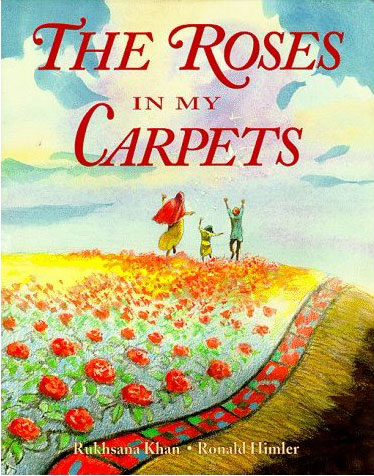
The concept of “refugees” is not a new one, but with the pervasiveness of the term in the news right now, children are starting to need some understanding of what it means to be a refugee, and how to empathize with what their classmates and friends may have endured. Books like One Green Apple, The Red Pencil, and Four Feet Two Sandals are great, and I excitedly hoped this one would be a great addition to the theme.
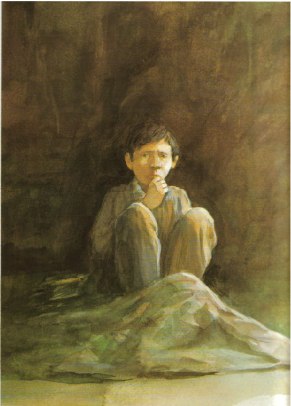
The book is leveled as an AR 3.2, but I don’t know that many eight and nine year olds would be able to grasp some of the content unassisted. This is a good example of the limitations of Accelerated Reader. Yes, diction and sentence length are third grade level, but content is a bit heavy in this 32 page water-color illustrated book.

A young boy is telling the story of his life in a refugee camp in Pakistan. The nightmares of jets dropping bombs opens the story and sets the tone of a very frightening reality that this boy, his mom, and his sister Maha face. His father, a farmer, had been killed, and I think the author does a good job of showing readers that although the characters are now in a refugee camp, food and safety are still not a given. I think we as westerners tend to think, ok they had to leave their home, and that is sad, but now they are taken care of, and this book clearly shows that, that is not the case. The boy mentions that someone has sponsored him and helps them with money, something his father wouldn’t have accepted, and I’m not sure why this is included. Perhaps to show that people still can help and need to, or to show that affluent people donate as a way to ease their conscious without working to fix what caused the problem in the first place? I don’t know. It would lead to some good discussions with older children, perhaps fifth grade and up, as the author doesn’t make it a good or a bad thing, but does introduce it none the less.
The environment is drab, “Here, the walls are mud, the floor is mud, the courtyard is mud, too” and the day-to-day chores monotonous, lining up for water, for food, going to the mosque to pray, and going to school. For some reason, not sufficiently explained in my mind, the little boy hates school. A sharp contrast to stories that show how appreciative many children in other parts of the world are at the opportunity to study and learn. The boy rather, loves weaving. He looks forward to escaping his reality and getting lost daydreaming in the weaving of beautiful colorful images where the bombs can not get him.
The characters are clearly Muslim, as they pray and wear hijab and go to the mosque. They trust Allah when they are faced with challenges, but no details of belief are conveyed and it simply describes the characters. The book does not come across as whiney to me, and while there is some hope that radiates through when the boy is weaving, it really is a sad book. It is made more depressing when Maha is hit by a truck, she thankfully survives with broken legs, and by the thought that although the boy wants to use his weaving to provide for his family, the future doesn’t seem bright. In the end perhaps running free on a rose filled carpet where the bombs cannot get them only exists in his dreams, a sobbering thought for the characters and readers alike.