Tag Archives: 2nd to 4th

Night of the Moon By Hena Khan Illustrated by Julie Paschkis

Standard

night of the moon

Night of the Moon is a beautiful book both visually and content wise.  The pictures are bright and inviting and consume the entire page, keeping even the youngest of listeners engaged.  The book has an AR level of 4.1 and has 32 pages, making it work great for story time and well for independent readers too.

The book tells of seven-year-old Yasmeen, a Pakistani-American girl experiencing Ramadan. The story is moved along by the ever changing phases of the moon. While this book is adequately called a Muslim Holiday Story, it is very cultural.  The characters go to the mosque, but the focus of the story is not why we fast, the revelation of the Qur’an to Prophet Muhammad (peace be upon him), or even manners.  The story focuses on going to iftar parties, having henna painted on your hands, presents, and the very Pakistani-tradition of celebrating chand-raat, the night of the moon.

I like that this book shows Yasmeen talking about Eid at school with classmates of other backgrounds, I even like that her grandma wears hijab and her mother does not.  I also like that they eat a variety of foods, from kebobs to cupcakes.  Thus far, so many of the Ramadan and Eid books I’ve read contain the same information in a fictionalized setting, this one is definitely different, instead of focusing on what Ramadan is, it shows how it is celebrated.  The book works well for Muslim and non Muslim children from all around the world.  If your audience lives in American and has ties to the Asian subcontinent they will see them selves in this book, and even if they don’t, they will probably want to join Yasmeen and her family is celebrating Ramadan and the Night of the Moon.
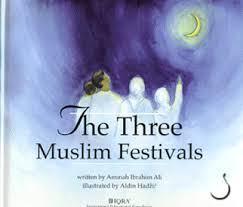
The Three Muslim Festivals By Aminah Ibrahim Ali Illustrated By Aldin Hadzic

Standard

Image

The Three Muslim Festivals is a very informative book about Ramadan, Id al-Fitr, and Id al-Adha, at over 60 pages however, it is a bit long for story time or smaller children.  Broken up into three parts, each told from a different character, the book would work well for second through fourth grade students.  It reads like a very basic chapter book, with information mixed in with a simple story.  The morals are clear, hadith, ayats and dua’as are shared and the illustrations help support the fictionalized portions.  The pictures aren’t engaging, but they do show a variety of ethnic groups and happy families.  The book is content, not character driven, but the families are supportive of the children, there are actively involved moms and dads, grandparents, and siblings.  The mom in one story is a physician and the dads help in the kitchen and around the house, showing some diversity. I like how it serves as both a review of basic Islamic principals while reinforcing elements that a child may not know or may have forgotten in a non condescending manner.  I would imagine the average seven year old could read it independently and comprehend it without being bored.  It isn’t the best written story out there, but it should be engaging enough to convey a lot of good information to an elementary aged reader.  Based on the style it is probably more intended for Muslim readers, but there is a three page glossary of terms in the back.

Eid Kareem Ameer Saab By Fawzia Gilani-Williams

Standard

This book made me laugh. It is essentially the story of Scrooge in the Christmas Carol simplified for a younger audience and switched to an Islamic perspective.  Don’t get me wrong, despite its unoriginal foundation, it is a good story.

The main character is grouchy, wealthy Ameer Saab who we see in a typical day berating his servant Raheem, refusing to help a woman and her young baby, refusing to help the poor, and neglecting his Salah.  Meanwhile Raheem is scrounging up his money with his wife to provide food, while still managing to help a widow, and others.  That night Ameer Saab has three dreams, in the first he is reprimanded by his father, the second by his mother, and in the third his money and jewels strangle him.  He wakes up a changed man on Eid morning.

This book is great for 2nd through 4th graders, with colorful pictures and well spaced text, it invites rather than intimidates this age group.  The morals are also clear and influential as the reader can see clearly which side is more desirable to Allah swt.

There is a verse from the Quran explained, and there are a few Arabic words, nothing off-putting for a newly independent reader and at just 24 pages, I think most elementary age students will enjoy and benefit from the story.

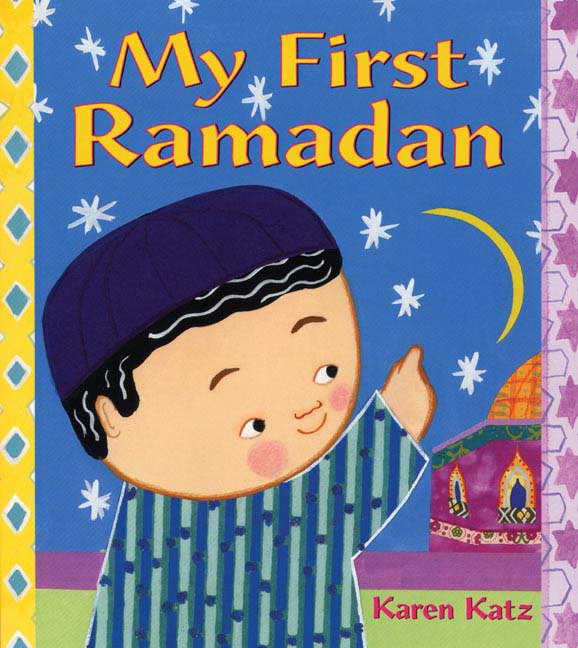
My First Ramadan by Karen Katz

Standard

my first ramadan
With Ramadan here my goal is to round up all my Ramadan and Eid picutre books to share (and hopefully review). Unfortunately school is out for the summer, so it will be mostly just sharing with my own children and nieces and nephews.

Karen Katz, a popular children’s author wrote and illustrated a children’s book about Ramadan and Muslims called My First Ramadan. It is an AR 2.8 and the pictures are done in her signature style, which the kids will recognize and love. Told from a little boy’s perspective he explains Ramadan, Islamic traditions, basics of Islam (Quran, Prophet Muhammad (peace and blessings be upon him)) and some of the five pillars. Words such as iftat, suhoor, fajr, maghrib, are introduced, explained and even have a pronunciation guide in parenthesis.

A few things that I discussed with my kids while reading are that in the picture talking about Prophet Muhammad (peace and blessings be upon him) teaching his followers to break their fast with a date and water, that RasulAllah is NOT pictured and why we don’t picture him. I also explained that each family has traditions, and the one in the book sits on the floor to eat. Islamically it isn’t required. We also talked about why in the book the men and women are in different rooms when they pray and in some Masjids they are in the same room, the men in front and the women in back.

The book mentions and illustrates how happy Ramadan and Eid are, and how Muslims come from all over the world. In the pictures some woman cover, some don’t, but we are all family. All in all a cute book that introduce and reinforces Ramadan.

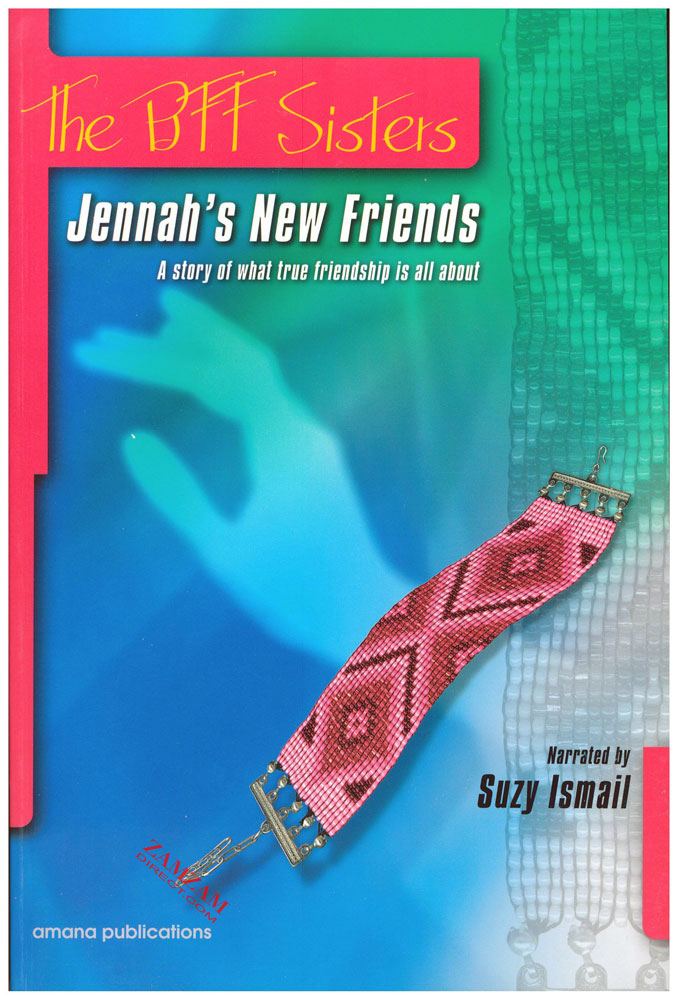
Jennah’s New Friends By: Suzy Ismail

Standard

ImageThis book is presumably book one of the BFF SISTERS series, however, the author’s website doesn’t list any other books in the series and it was published in 2001, so it is unknown if more books are in the works.  At 64 pages, the intended audience is girls between ages 7 and 12, but I would note that there are no illustrations and while it is broken into chapters (on average about 10 pages long) the text and layout would be daunting to the average 2nd and possibly 3rd grade student. 

SYNOPSIS: 

Jennah lives in a neighborhood with lots of Muslims and lots of friends, but when a new girl moves in, Jennah is afraid that her best friend Yasmeen would rather be best friends with the new girl, Mariam.  Jennah not only is afraid of losing her friend, but there is a lot going on at home too, her mom is about to have a baby, her younger sister is always bothering her, and her dad is constantly away on business.  Alhumdulilah, Jennah is surrounded by supportive adults, forgiving and generous friends, and an Islamic foundation that allows her to sort out her feelings and create a Hadeeth club with All her new friends.

WHY I LIKE IT:

I love that it is a clean book for the elementary age group, the girls do not have boyfriends and while hijab is mentioned in passing, the girls are a group of kids that are dealing with the constant struggle of all girls that age: friends.  Each girl in the BFF club is from a different background, Arab, Pakistani, African American, one’s parents are converts, and at the end a non-Muslim joins the group, truly someone for every reader to identify with.  I think most every girl reading this book can relate to the struggles amongst friends, being the new kid, having younger siblings, trying to fit in, and jealousy, all topics touched on, however the book is an awkward read.  I can’t decide if the book is a short story that got too long, or a novel that wasn’t fleshed out.  The beginning drags on as the foundation of who all the characters are is established, and at times Jennah seems very whiney and immature with problems that wrap-up with little explanation or insight.  Everything often seems too “perfect” and Jennah’s problems petty when all the surrounding characters are so over the top forgiving and generous.  The book left me wanting to know more about the backgrounds of the supporting characters, and more about how Jennah felt.  I think readers may get lost with all the characters, but if they can sort it out, I think they will see themselves and their friends in the pages dealing with the same issues they deal with every day.

FLAGS:

Clean

TEACHING THIS BOOK:

I probably wouldn’t teach this book for the intended audience, or share it as a book club, however, one-on-one the book would be a great starting point for a discussion with a girl having problems with friends. 

Ibrahim Khan and the Mystery of the Roaring Lion by Farheen Khan

Standard

Image

Perhaps it was timing, or maybe the book just lacks a lot, but having just read Rashid and the Missing Body, did not do this book any favors. This book also features an elementary boy working to solve neighborhood crimes,. who just happens to be Muslim.  The target audience would probably be any 2nd to 4th grade student, girl or boy, as it is a quick, clean 45 pages.  The book is beautiful from the outside, the font and pictures inside are spot on, the story itself isn’t half bad, but the rationale for the crime and the conclusion, just seem  weak and forced.

SYNOPSIS:  

Ibrahim Khan and his cousin Zayn are third graders that solve crimes in their part time.  One day they get a call from Yusuf that there are lions in his backyard, he can hear them, but can’t find them.  The Khan boys are on the case and with support from parents picking and dropping them off at each other’s homes around salat times, and their trusty brown bag, they figure out what is really in Yusuf’s backyard.  

WHY I LIKE IT:

The book is clean, it is perfect for a young or struggling reader in terms of presentation and writing style, and is a decent foray into Islamic fiction for elementary aged students. There is no unnecessary religious, or family, or boy/girl drama, but the reason for the perpetrators scaring Yusuf is very, very unbelievable and weak.  Without giving it all away, it may work to talk to your child at the end about the moral, but I think any student in a school setting would find the ending a bit disappointing.

FLAGS: 

None. Clean and framed well to give the reader a sense that Ibrahim comes from an Islamic family and environment, he is a Muslim, and at the same time he has friends and adventures just like any other character in any other book.


Rashid and the Missing Body By Hassan Radwan

Standard

Image

I picked this up in my school library and started to read the small and uninviting text (it looks like an essay) and was quickly swallowed up by the kid detective story of not only who-done-it, but how.  At 80 pages, the book is both compelling and charming, in its simplicity and ability to bounce around.  The back of the book suggests the book for ages 11 to 15, but I think it would appeal to anyone seven and up, particularly boys. The book is not AR, but I plan to make a quick 10 question quiz so that students can read the book and get class credit by logging in, taking the test, and hopefully passing.

SYNOPSIS:

Rashid and his new (non-Muslim) friends are playing a simple enough game of cops and robbers when they stumble upon a dead body in a shed at the park.  The rush home to call the police, but by the time they return, the body is gone.  The story is the adventures of the boys trying to figure out what happened and how to make sure the culprit doesn’t get away with his crime.  The backdrop of Rashid’s family, his Muslim and non Muslim friends, a few bullies, is all beautifully woven into a moral and uplifting story where the characters are practicing Muslims, and the supporting characters are respectful to the point that Rashid’s religion is a non-issue, just a strong defining characteristic.

WHY I LIKE IT:

Superficially the book appeals to a hard to inspire boy demographic, that alone prompted me to pick up the book.  I love that the book doesn’t get bogged down in preaching, it truly comes from a Muslim perspective of handling Islamic events in your daily life, and in this case solving the case.  When scared Rashid asks Allah for help, he prays, he fasts in Ramadan, he helps his brother, the author has Rashid’s sister get married and has Rashid’s annoying cousins come over; there is no over the top drama in the home life, the suspense and climax of the book is the dead body, not who Rashid is and what he believes.  I think to see a character so like themselves tracking down suspects and having such a grand adventure will be a big hit with our students.  I don’t think it lends itself well to a book club book, but I can’t wait to recommend the book to individuals.

FLAGS: 

Clean.  As the back of the book says “It brings into play life-enriching Islamic values of standing up for truth, a strong sense of duty and bond of sincere friendship.  The story throws light on Muslim family life, their morals and manners and outlook on life.”


The Meat Eating Vegetarian by Caroline Maryam Ward

Standard

ImageA quick read even for the 2nd through 4th grade age group with 44 pages, lots of pictures, and generous spacing.  I  feel it could have been done as a picture book, but for the age group and the fact that it is hardback, the book does sit nice on a shelf and encourage a budding reader to open it up and not feel intimidated.  The book is written in British English, so my daughter had a few questions regarding terminology and spelling, which alhumdulillah, gave us a chance to talk about a different culture (albeit a different one than the book was targeting).

SYNOPSIS:

British born of Pakistani heritage, Tasneem starts a new school in the fall, she quickly becomes friends with Yvonne and Lisa.  After a play-date at Tasneem’s house however, Lisa and Yvonne feel Tasneem has been lying to them about wearing a scarf and eating vegetarian lunches every day in the cafeteria.  Their teacher helps facilitate a dialog and the girls learn about zabiha, rules of hijab, and the importance of communication in a friendship.

WHY I LIKE IT:  

The book is not preachy, Tasneem is Muslim, the other girls are very nice, it is a simple story that helps a Muslim reader see that one can be true to themselves in any environment and succeed.  In terms of identity building it is great to see mixed characters with open minds, but at the same time not present it as trouble free, which is something it often is not.  The only hesitation in recommending this book that I can foresee, is within the Muslim community there is division on Zabiha/Halal.  Tasneem does tell her friends that because she is still young, the hijab is not mandated for her, but the meat issue will either be amazingly relative to a student, or incredibly off putting, depending on their background.

FLAGS: none, completely clean, Alhumdulillah


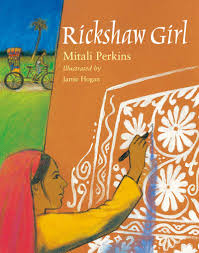
Rickshaw Girl by Mitali Perkins

Standard

Image

The book Rickshaw Girl by Mitali Perkins was recommended to me by the same person that suggested Overboard, (thanks Cheryl) as it is a rare book that appeals to the often difficult to find 2nd to 4th grade demographic.  The book is 91 pages, with large drawings and a fairly large font.  I read it in about 30 minutes and I’m sure most students, not slowed down by the names, could easily read it in a few hours.  It is that engaging and vivid that I think most students, boys included, would have a hard time putting it down.  The AR level is 4.3, but I think the gender issues would be relate-able in an Islamic School setting to advanced second graders.  I am considering obtaining a few more copies and letting the younger students that really want to be in the Book Club read this book and give it a try; or reading the book aloud to the students and then discussing it with them, will talk to some teachers and post back what I opt to do, inshaAllah.

SYNOPSIS:

Set in Bangladesh, Rickshaw Girl is a sweet story about 10-year-old Naima, who is smart and caring, and at that critical age where she can no longer play freely with her best friend, because he is a boy, she must start helping her mother in tending to the house, and because of financial restraints can no longer continue her school education.  Frustrated by the fact that as a girl and she cannot financially help her father, as a son would be able to do, she makes a poor decision that causes the situation to get worse (don’t want to spoil the book by disclosing what she does). Her personality and inner strength, however, push her on a path to correct her mistake and help her family, proving girls can definitely rise above restraint and succeed in following their dreams.

WHY I LIKE IT:

One could/would assume (dangerous I know) that the characters are Muslim, it is never stated, never implied, never brought up.  In the pictures the female characters have a scarf draped over their hair, but in that part of the world, most every woman would.  Same goes for the gender issues.  That being said, I think it would lend itself very easily to a discussion of what most Muslim girls experience in general terms of being slowly discouraged from playing with boys, encouraged to start helping in the kitchen, etc.  I love that the story is fast paced and that you truly cringe at Naima’s actions, and cheer for her to try and fix her error.  Her family situation is also very soothing.  Her parents are strong and loving and kind, and I think how most 10 year old children see their families.

Flags:  None, clean

TOOLS FOR LEADING THE DISCUSSION:

The author’s own page is helpful in getting the ball rolling, there is also information in the back of the book: glossary, author’s note about microfinance and how to wear a saree.

Click to access RickshawGirlDiscussionGuide.pdf