Category Archives: mature

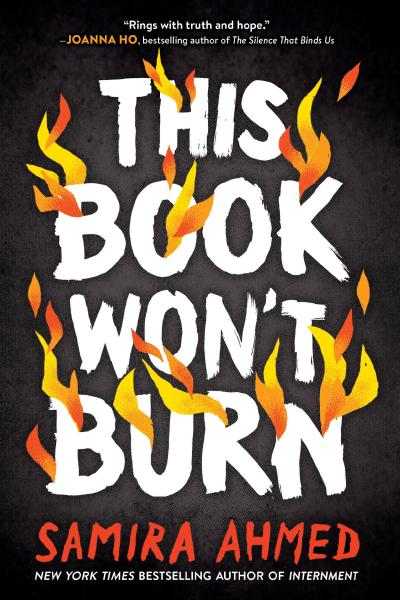
This Book Won’t Burn by Samira Ahmed

Standard
This Book Won’t Burn by Samira Ahmed

burn

It is clear that this 384 page contemporary YA book is about the hot topic of burn banning in America, and I would imagine most are aware that the overwhelming number of books that have been recently banned or pulled because of objection, are by BIPOC and queer authors featuring BIPOC and queer themes and representation.  So I read it not so much to see the author’s perspective, but more to see how the Muslim author had the Muslim identifying characters in the book approach the topic.  The book is very black and white: book banning is wrong, Republican right wing MAGA members are fascist, and liberal freedom of speech supporters are LGBTQ+ identifying and allies and upholder of first amendment rights.  Islam and the character’s Indian heritage is ingrained in the characters’ being, and a label they are comfortable with, unfortunately, it has no impact on how they act, think, or the lens in which they view their world. Every 50 pages or so some vague mention of Ramadan, or a tasbeeh, or mosque appears, only to disappear just as abruptly. The Muslim protagonist, Noor, likes two different boys, is often alone with one or the other, nearly kisses both, and with the support of her family attends prom. Her younger sister, Amal, is unsure if she wants a boyfriend or a girlfriend, it is not a major part of the story and is just mentioned in passing.  A major side character is lesbian, and starts a bit of a relationship with another girl, they hold hands, and there are a few kisses on cheeks, nothing overly detailed.  There is profanity in the book, arson, threats, racism, and stereotypes.

SYNOPSIS:
Noor and her family move to a small town from Chicago when her dad abruptly abandons the family.  It is the end of Noor’s senior year, and with the grief, stress, and emotional upheaval of her family, Noor just wants to get to graduation.  Quick friendships with Faiz and Juniper, and realizing that she is the daughter of her activist parents though, thrusts her into making enemies her first week in the conservative town by questioning the school’s book banning policies. Add in her strained relationship with her mom, her conflicting feelings for Andrew and Faiz, and her sisterly concern for Amal, and Noor has a lot on her plate as she shakes up a small town.

WHY I LIKE IT:
The first chapter is incredibly written, no doubt.  I hated the dad, actually more than that, I was so disappointed in him, and so concerned for Noor, Amal and their mom.  To feel such strong emotions for characters just introduced is a testament the author’s abilities.  Sadly, insight into why their dad left never came, and  perhaps no answers is something the characters had to grapple with, but as the reader, I felt it wasn’t really explored, or articulated, it just was unresolved, and I really wanted some closure.  In terms of literary quality, the book went down hill pretty quick for me.  The middle was slow and repetitive with the heavy handed views on book banning.  Some shades of gray, or some discourse would have prodded the readers to maybe think about the implications of banning books, but the narrative never allowed for that.  It is right vs wrong, us vs them from the start.  There really is no growth of the protagonist, she doesn’t have much of a character arc, and the supporting cast is not fleshed out.  I wanted to see more of Noor and her Mom, not just be told repetitively how absent she is, I wanted to see Faiz as a full person, not just the only other brown Muslim at the school and who likes to cook. Where are his parents, do they support his activism, that he is going to prom? Truly, there is no Islam in practice it is just a label that gets dropped when it furthers the notion of raging against an established bias system.  I’m not saying they need to be praying and reading Quran on every page, but I don’t know that the story would be much different if the family was not Muslim Indian American. Really the catalyst is that they are a new family, and a visible minority.

FLAGS:

Straight and LGBTQ+ relationships, arson, threats, stereotypes, racism, bullying, cursing.
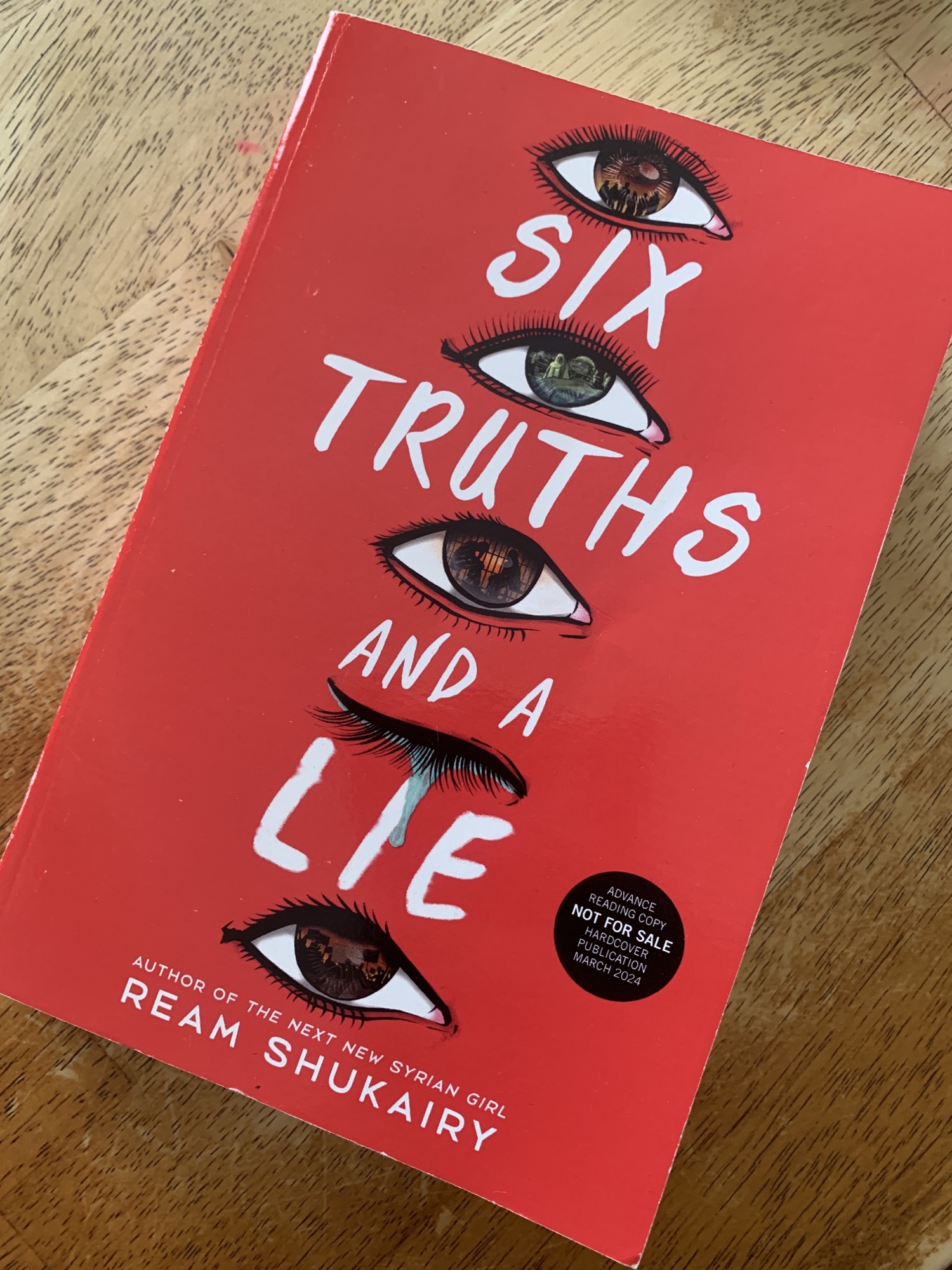
Six Truths and a Lie by Ream Shukairy

Standard
Six Truths and a Lie by Ream Shukairy

Woah baby, that was a wildly fantastic ride of a read.  The very first page grabs you and makes you sit up and pay attention.  I have never been so happy to sit in a waiting room so that I could read in peace.  This 387 page book is mature YA, I was gifted the knowledge prior to reading that there is a line that is toed, possibly stepped on, but not carelessly crossed, so I will gift that knowledge on to you, so that you might enjoy the story without that anxiety. Told from numerous perspectives, a group of Muslim teens find themselves arrested for an act of terror.  Strangers from different schools, different backgrounds, and different dreams for their future, are fiction, but their stories, their secrets, the broken system that they find themselves in, all feels very real.  The plausibility and commentary from an OWN Muslim author is incredible, I do wish their was more spiritual centering, Islamic framing, or even a more Muslim conscience present. Some of the characters do discuss hijab and one does find solace in prayer, but none of them really pour their heart out to Allah swt in the isolation of their cells, and in the predicament they are placed in, and it seems like they would.  Ultimately though the writing is remarkable, it has been a long time since I was truly tempted to skip ahead and read the last few pages because my heart was racing.  There is just one storyline thread that is so overly emphasized that comes close to a haram line, that I wish was a little down played so that I, as an Islamic school librarian, could encourage younger teens to pick up the book and dive in.

SYNOPSIS:
It is the fourth of July, and the MSA kids from the local different high schools are gathering at the beach for bonfires, fireworks, and socializing.  Everyone present will witness a crime, six teens though will be accused of committing it.  Qays, the Palestinian golden soccer boy who can charm everyone and anyone.  Nasreen, the outcast from a private Catholic school there to meet someone.  Samia the hijab wearing social media star. Muzhda the Afghan refugee with undocumented parents.  Zamzam the girl with a singular dream to be a doctor, and Abdullahi, the quiet EMT in training.  Six strangers whose histories and alibies link them to the outside world, but leave them skeptical of one another as they face charges in a world not concerned with the truth.

WHY I LIKE IT:

I love that the characters are Muslim and feel so real and developed. The characters are not tropes or their families stereotypical.  They know what Islamophobia faces them from others, they know what internalized issues they are dealing with, and they are not having a religious identity crises amidst everything else they are experiencing.  The writing allows each voice to be unique and clear, which is quite impressive as there are a lot of perspectives that move the plot along.  It is really hard to write a review that doesn’t spoil the book, so yes I’m being vague, and you are welcome.

FLAGS:

There are a lot of profanities not just when the stakes are high, but normalized as well throughout.  There are close relationships between boys and girls.  They take about dating.  There is weed, and the legalities of using, being in possession, and being high.  There is lying, death, incarceration, Islamophobia, some physical abuse mentioned.  There is a story line of a girl that doesn’t know if she is attracted to girls, she doesn’t act on it, but it is something that has tangled up her alibi and she choses not to explore it, but it keeps coming back up.

TOOLS FOR LEADING THE DISCUSSION:

This would be an awesome mature YA book club, just like some of the characters are being held in juvie and some being tried as adults, I think for Muslim readers a little older will benefit and be able to process, discuss, and see themselves in the book.  The book mentions that it could happen to anyone, and for a Muslim audience, to recognize and discuss that concept would be beneficial and engaging.

The Grimoire of Grave Fates by Hanna Alkaf and Margaret Owen

Standard
The Grimoire of Grave Fates by Hanna Alkaf and Margaret Owen

I keep saying I won’t read anymore anthologies or collections, but this 464 page YA fantasy mystery intrigued me because each chapter is written by a different author, presenting a different character to unravel a whodunit.  In total there are 18 character perspectives, 18 authors, and one murder that needs to be solved.  With two Muslim authors included and it created by a Muslim writer, I hoped there would be some Islamic representation.  The list of authors is quite diverse, and I think every character presents some minority label to normalize a specific culture or identity.  The Muslim characters both wear hijab, but nothing more about their religion is mentioned and no other faith is included.  There are Black, Asian, Hispanic characters, and every letter of LGBTQ+ is highlighted and seemingly the focus of the book.  At times it is just attempted normalizing that a character is queer or gay, but other times it is central to the plot such as when two girls spending the night together provides an alibi, and a few times it really takes away from the story, for example at one point two boys (one magical, one neutral) kissing and falling in love.  There are gender fluid, non binary, pronoun preferences, trans male-to-female, female-to-male characters as well. I kept reading to get to Hafsah Faizal and Karuna Riazi’s chapters, which were 10 and 12 and by then I was so close to the conclusion, I just finished.  Some chapters are stronger than others, but the resolution was really anticlimactic and didn’t do the buildup justice.  I share this review not just to comment on the story, but to also give a heads-up to the content so that you can decide if the book is suitable for you and your children.  I would not shelve this book in our Islamic school library, which is unfortunate, because I think even with the weak ending, I like the theoretical storytelling concept.

SYNOPSIS:
In moving school for magical students, a murder has been committed, and the students who all feel like they are the “chosen one” are determined to solve the case.  The characters share what they know and add to the “solving” of the case for the reader with their different magical abilities.  Some of the students are werewolves, some necromancers, there are those whose dancing is magical, others whose embroidery is, a few are the same, many are unique.  They don’t compete with one another so much as they are in their own world trying to prove their worth and right to belong.  When a homophobic, racist teacher “dies” secrets are uncovered and dirty administrators are called to account.

WHY I LIKE IT:

I like seeing a glimpse of the action from a character and then not really seeing that character again, it made it seem more puzzle-like in the coming together of the clues.  I also liked it because if I didn’t particularly like a character or writing style, it didn’t last the duration of the book.  I wish it didn’t feel so token representation though.  If the goal was to be inclusive, the mirroring uniqueness was lost when each character seemed to have to tick a box.  It made it read formulaic.

The conclusion just unraveled, and I know mysteries and horror stories tend to fall in to this trap, but I was hoping it would go out with a bang.  The buildup was strong, but then it became a lot more just telling, then sleuthing, and I don’t know if it was a reflection of the individual authors, or the overall arc of the book.  Either way, I felt like it could have concluded with a bigger punch and wrapping up of some of the loose ends.  Hanna Alkaf didn’t have a chapter, presumably she wove it all together and made it flow cohesively with the internal memos and emails and notes.

I wish the two “Muslim chapters” would have had some more representations about Islam or the girls’ cultures influencing their magical style or goals, but with token rep it is often just a label, an identifier, and then nothing more.  The two connect over fear of Islamophobes blaming them for the death of their teacher.

FLAGS:

The focus of the book is largely on relationships, mostly LGBTQ+ but some hetero crushes as well.  Trans, non binary, gender fluid, bullying, racism, prejudice, murder, magic, lying, sneaking. The Muslim characters do not have crushes or romantic relationships mentioned, but one has a close male identifying gay friend that she does have physical contact with, a reassuring hug- so the book does have Muslim girls with close male friends. Fear of Islamophobia, stereotypes.

TOOLS FOR LEADING THE DISCUSSION:

I would not be able to teach this book or shelve it in an Islamic school.