Tag Archives: self help

The Power of Du’a by Aliyah Umm Raiyaan

Standard
The Power of Du’a by Aliyah Umm Raiyaan

img_8062-1

Having not read the author’s first book, Ramadan Reflections, I wasn’t sure what to expect with this non- fiction/memoir/anthology/self help/spiritual focused book. Alhumdulilah the tone is easy to read, the chapters consistent in their format, the quotes and passages sourced, the personal stories relevant, and the information often moving and inspiring.  At times it did feel repetitive, but ultimately the book has staying power, and now that I have read it once cover to cover, I can see myself picking it up and reading a chapter or two at random and being again drawn in again.  While nothing in the book seemed “off” I did find myself wondering though, what qualifications are needed to write a book such as this, and did not find the author’s bio satisfying in providing that information.  Yes, there is a statement of praise by Mufti Menk on the cover, but similarly I don’t know if that means he “checked” and “approved” the book, or just liked the concept of it.  Ultimately, I don’t know that it matters, but I do feel it is worth disclosing, since it did linger in my mind, and I would have appreciated some transparency in the matter.  The 258 page book is meant for adults, but older teens will find it valuable too, even if a number of the stories are related to pregnancy.  I love that this book is traditionally published in the UK, it is for Muslims by a Muslim, but the glossary at the back and the way it is written, would allow even non Muslims to be drawn to the beauty of conversing with our creator, subhanAllah.

The book is divided into four parts: Du’a of Need and Want, Before Du’a, The Du’a, After Du’a, and each of the parts has multiple chapters that explore, develop, and illuminate the concept heading.  Each chapter starts with an ayat, or hadith, or quote, then gives a personal reflection of what the chapter sets out to do, and how the story about to be shared came to the author.  A personal du’a story from a real person is then shared.  The author then uses examples from the story, along with hadith, examples from the Qur’an, and/or guidance from scholars to build the case of the chapter’s intended goal.  Often there are then action items in a pull out box of suggestions the reader can do to “Develop Your Du’a” or strengthen one’s connection.  The final paragraph of the chapter is, “Allah, Transform My Du’a” where an example is given of a how to phrase your du’a.

I love that you can implement every single bit of knowledge into your du’a and your day, immediately.  If you read a chapter, you have something to ponder and act on, if you read multiple chapters you have more.  The implementation is easy and accessible, because of how it is presented.

Many of the stories, and the lessons from them are emotionally humbling.  I often found tears on my cheeks as I saw my own vulnerability, fears, worries, and hopes expressed on the pages.  And the passages that moved me today, I could see having a different effect on me if I reread them in the future.  Similarly, pages I skimmed, I have no doubt could truly grip me in the future as well.

I’m glad I own the book, glad I read it, and can see me recommending it, suggesting it, and gifting copies to others. The importance of du’a and the balm it provides is something we all know, but how to go about it to make the most of it, is often something we need assistance with and can be facilitated by this book, alhumdulillah.

The Young Muslim’s Mindful Book of Wellbeing by Zanib Mian

Standard
The Young Muslim’s Mindful Book of Wellbeing by Zanib Mian

wellbeing.jpg

This tiny book (5.5 inches square) is non fiction and I’m reviewing it, because I think it has a lot of value and will appeal to the parents that check out this site for book suggestions for their middle grade children.  The flower on the cover and the topic, might naturally turn away boys, but the depicted character that presents the information is a boy and while it is a token gesture, it is a nice one, to try and make the book and it’s contents appeal to all children.  Irregardless of if you have teens, or tweens, or toddlers, girls or boys, I think parents should read the book and use the concepts and framing presented when talking with their children.  At least that is what I hope to do.  One doesn’t need to wait until their child comes home crying from friend drama, or losing out on something they desperately wanted, to implement the lessons and reassuring bits of mindfulness, it should be the established foundation of how to handle emotions in a healthy way, inshaAllah.

SYNOPSIS:

The book is broken into 14 chapters based on topics covered, and the directions encourage the reader to read them all in order the first time through, then going back to certain sections as needed.  The headings include: How to be happy, A Way Out of Every Problem, How to Feel OK If You Wanted Something, but Didn’t Get It, Friends, Feeling Sad, and Talking to Allah.  The information is presented in a positive reassuring manner that helps the reader to feel like others have felt this way too, and to try some of the suggestions.  It doesn’t belittle or talk down to the feelings one might be having which is great, as the concept of Allah (swt) is incorporated onto every page.  Strengthening ones relationship with Allah as a way to cope with stresses and know that He is always there, is the central theme throughout.

The book offers advice on dealing with negative people, negative thoughts, and finding your own positivity and strength with the help of Allah no matter what.  The book isn’t dry though, it engages the reader and uses examples children can relate to and comparisons that are tangible.  At one point the book talks about shields that reflect back whatever you are giving off.  So when you are shining from the inside, you feel better, and so do others around you.  When talking about seeing the bigger picture, the book urges the reader to consider seeing an entire room through a key hole and likening it to how we see our own lives seeing only what is happening right now.

The book also takes into account that somethings may take work to feel better, and that it isn’t an easy fix to feel good, but inshaAllah worth the effort.  The end summarizes in two points what the previous 36 pages articulate and explore, concluding how to make you shine and be your best self.

WHY I LIKE IT:

I love that we are talking to and with children, not just toddlers, about their feelings.  We aren’t telling them to just cheer up or be happy or get over it.  We are giving them tools that they can carry throughout their lives, inshaAllah.  The pages are text heavy, granted the book is small, but the book is thick and the amount of words on the pages could intimidate some, but like I said earlier, even if the child won’t read it, parents will benefit from it and implementing it in the home.  Also just having the book sitting around will urge kids to pick it up and thumb through it, I would almost guarantee it.

My critiques are the presentation.  I am no expert on the content and what I read seemed logical, and I liked it.  Vague I know, hence I don’t review non fiction often, because what do I know?  As for the physical annoyances of the book, it is too small.  It doesn’t need to be huge, but for the topics covered, it is trivialized by the size, in my opinion. 

I don’t mind the font, I mind that it changes size so often and for no other reason it seems than to fit everything on the page.  Nearly every chapter is a different size font, but sometimes its even within the same chapter.  A few times for example the page on the left appears to be a size 14 font and the text in the same chapter on the right is like an 11, making it seem inconsistent and jarring..  If the idea needed to be bolded, or shouted or whispered, I support playing with font size, but this is not the case, it is so that the picture and text can all fit without having to turn the page, and its not the best solution I feel, its too distracting. 

IMG_2672.jpg

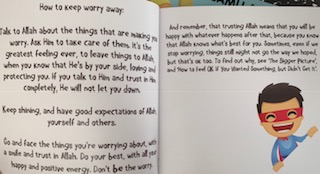
The other inconsistency that I found a bit odd, are the illustrations.  The little boy on the cover with his yellow flower and yellow shirt take you through maybe 80% of the book, but on occasion other characters pop up, which is fine, when they are drawn in the same manner, like the frog.  But the random appearance of the full color super hero, reminiscent of My Dad’s Beard book, and the full color Migo and Ali looking bears, there’s also a one time appearance of a girl in full color, seems bizarre.  I don’t see the cameos as adding a shoutout to the content and author, but more like the books from the 90s that used free clipart to illustrate the pages that otherwise would be text only. 

FLAGS:

None

TOOLS FOR LEADING THE DISCUSSION:

I think this would be a great book for a school counselor to use as a guideline for group discussions.  I think it could be done from the library, but a counselor and students would really benefit from the book and the manner in which the material speaks and empowers youth to shine.