Tag Archives: Oppression

Jasmine Falling by Shereen Malherbe

Standard
Jasmine Falling by Shereen Malherbe

jasmine

This 184 page book about a girl figuring out her past, to accept her present, and plot her future. is not marketed, or perhaps even written as a YA novel, but I’m reviewing it because while the protagonist is in her 20s the book could be enjoyable to ages 15 or so and up, if they are willing to stop trying to understand a lot about the book and are content to just go along for the heartfelt ride.

SYNOPSIS:

Jasmine is half Palestinian and half British and when her wealthy mother passes but stipulates to claim her inheritance Jasmine must find her father, the book leaves England and heads to Palestine.  To further complicate things she has only 10 days to find a father who has been missing for years, in a land she has only visited once before many years ago.

Once in Palestine, the story takes her from one city to the next and one village to another with pit stops at various historical sites along the way.   With lots of fragmented memories, the shadow world of Jinns, and a race against time and around the obstacles of the occupation, Jasmine rediscovers Islam, her family history, and the fears that haunt her.  She also meets Josh, a character of questionable allegiances, motives, and background himself, that constantly finds himself able to help Jasmine and possibly himself.

From Jericho and Jerusalem and Batien, Jasmine hears stories about her father from people that know her family,  as she pieces it all together and reunites with her family members, she understands her past and works to determine what path her future should take.

WHY I LIKE IT:

I love the backdrop of Palestine and the history and the richness of culture that is brought to light in a surprisingly non political way.  The interaction of the different faiths among the villagers and the love of the land is truly palpable.

The part I struggled with was the holes in the story telling, for each page that brought Jasmine closer to answering her one question of where her father is, the reader was given 27 new ones that would never be answered.  Where did the wealth come from, how did Jasmine’s parents meet, what were the circumstances that made Jasmine’s dad leave, who is Richard, who was Ali, how old is Jasmine, why are there so many Jinns every where, why is there secret passages in the mountain, how come she trusted Josh, how could Josh get from one city to another in record time, why did the soldiers at the check points know of her family and specifically her father, and most importantly why every time she meets someone that knows her family, why does she run away.   It is incredibly frustrating that every time the story hints at what makes her father so famous, or sought after or memorable, or hint at why he disappeared, something interrupts them and the reader is left in the dark, only to have the book end and no really understanding conveyed.

I get why the story is told in pieces, but really the story is confusing in how it is told, and it doesn’t need to be.  The author can write and the last 50 pages are really great.  For as confused as I was so often, I kept reading because the story is good.  There is just a tad too much with diving in to the past to understand the present, the supernatural of the jinn, the reemergence of faded memories and dreams, the political climate, the letters from World War II, that the character dynamics are lost until the end.  I care about Jasmine and am curious about Josh, but a little more detail to the relationships the two main characters have with all the other minor characters that they encounter would really make the story soar, and clarify so much.

One thing I didn’t love was the presentation of Jinns, I know it is to add cultural richness and a bit of muddled confusion, but really the story I think is strong enough without the supernatural and character building could have benefited in its place. I also really, really, really wished there was a map and an afterward telling what parts about Palestine and history and the Holy Cities is fact, for those of us that have never been.

FLAGS:

Jasmine attempts suicide, jumping out a window.  Jasmine also gets drunk a few times in the book before deciding to stop drinking as she doesn’t like who she is when she does.  There is some violence and killing talked about but not overtly detailed.

TOOLS FOR LEADING THE DISCUSSION:

I don’t think I would do this as a book club book, but I definitely would encourage those with connections to Palestine to read the book.  And I am really hoping that someone, anyone, that has read the book will chat about it with me.  For all the questions I have, I’m optimistic that I just missed the answers and that they were in fact there.

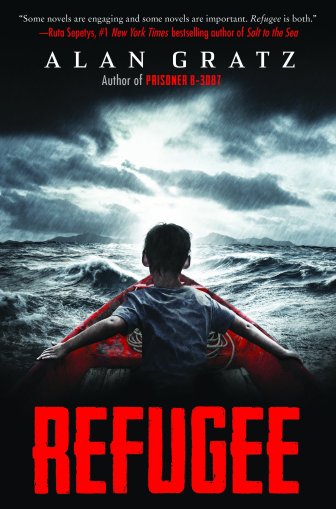


Refugee by Alan Gratz

Standard
Refugee by Alan Gratz

refugee.jpg

I debated whether I should read this book, or listen to it as an audio book with my children, ages 2,7,8,11.  The AR level is 5.3 and Common Sense Media suggests 10 and up because of the intensity, but knowing my kids are aware of some of the heartbreak the book discusses from other fictional works and the news, I decided to share this emotionally powerful book with them.  Tears were shed, discussion occurred, and the stories I pray will haunt and bother my children for years to come, inshaAllah resulting in compassion and action.  

The book is 338 pages with maps, references, ways to help, and acknowledgements at the end.  The audio book is just over seven and a half hours.

SYNOPSIS:

Three kids stories are told in pieces as they occur in different time periods, in different parts of the world, and for different reasons, but the heart of the stories are not the differences, but the similarities that all three share.  The real life parallels of each horrific event, and how small the world suddenly seems, is amplified by the ties that connect these fictional stories to one another.

Josef is a Jewish boy living in 1930 Nazi Germany.  When his father is released from a concentration camp; he, his mom, and younger sister Ruthie board the MS St. Louis headed for Cuba to try to find a new life.  However, Cuba refuses to let them in, and Josef’s father cannot escape the ghosts from his time in a concentration camp.  Returned to war in Europe, the family is once again on the run from Nazis and not all survive.

Isabel is a Cuban girl in 1994. Unrest is growing in Havana and when Fidel Castro says people can leave, her family: Grandfather, dad, and pregnant mom, join their neighbors in their makeshift boat to try to reach El Norte.  The shark filled waters, tankers, getting blown off course, and a temperamental boat engine, all pose as obstacles for the family trying to get on dry land to avoid being sent back to Cuba by the US Coast Guard.  

Mahmoud is a Syrian boy in 2015 who’s life has been altered by the civil war, but when their home is destroyed by explosians, they must leave right then.  His parents, younger brother Waleed, and baby sister Hana,  begin walking, their journey will travel through many countries as they seek the promised land of Germany.  Along the way they will be held at gun point, be forced into detention centers, walk for days and put their lives at the mercy of the Mediterreanean Sea in a flimsy rubber dinghy. 

WHY I LIKE IT:

I love that this book takes huge pivitol historic events in our life time and gives them a face.  Numbers are often numbing as they are difficult to grasp, and political motivations are often so hard to understand in their complexities, that this book does a marvelous job of making it about the person, about the humanity at stake.  I challange any one, especially those opposed to letting refugees in, to not cheer these three on, to not get irrated by those that willingly can help and chose not to, and those being relieved when people finally do see them and do help.  Its amazing how far a little kindness can go, and seeing it in tangible terms is powerful.  Yes, taking into your home a refugee is a huge kind step, but so was the giving of water and asprin to Isabel and her family, or giving of clean clothes and a ride to Mahmoud and his family, or removing the protrait of Hitler from the Social Hall during Josef’s Bar Mitzvah, all little kindnesses that hopefully we can rememember.

I love that the author got Mahmoud’s religion right.  They stop and pray, they make duas, their cell phone apps for salat times all ring at once, they are Muslim and their religion is mentioned as they practice it, not as a storyline.

Overall, I was impressed at the book.  Many reviews online found issue with the structure of the stories being broken up and seperated, but listening to it, atleast, made them feel incredibly connected.  I absolutely enjoyed seeing the parallels of each story and the humanity of each chacter shine through.

FLAGS:

The book has a lot death, and violence, and it is intense, but, it is not glorified and it isn’t too graphic.  It is done tastefully to make a point and keep it real, but not to overwhelm the audience or sensationalize the events, although I don’t know that any fiction, could be worse than the reality endured during these time periods.

TOOLS FOR LEADING THE DISCUSSION:

A map, would be awesome, a big one.  I like that the author gives some tips to help, but I think more on hand would be beneficial as the urge to help others is pretty intense after listening to/reading the book.  Especially ways to get involved in Syria, as the struggle is still ongoing.  

There are lots of tools online as the book is published through Scholastic. 

https://www.scholastic.com/teachers/lesson-plans/17-18/refugee-discussion-guide/

Book Unit Ideas: http://bookunitsteacher.com/wp/?p=5858

Author’s page: https://www.alangratz.com/writing/refugee/refugee-discussion-guide/