Tag Archives: middle grades

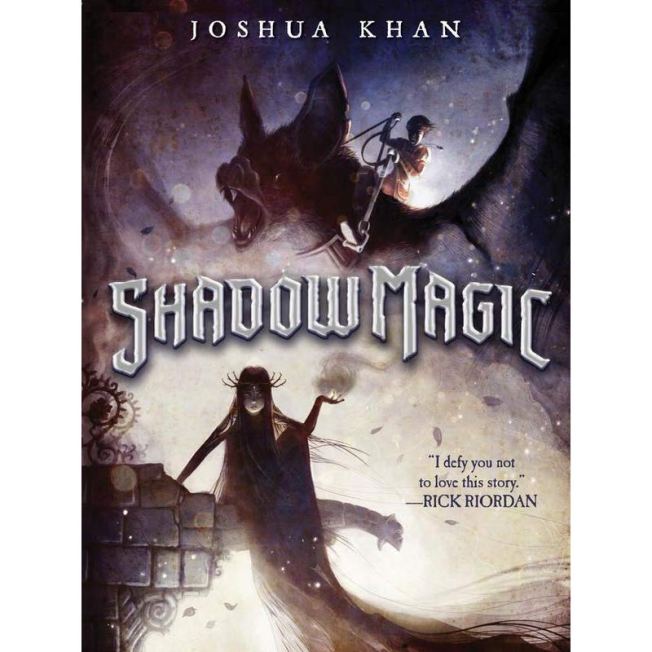
Shadow Magic by Joshua Khan illustrated by Ben Hibon

Standard
Shadow Magic by Joshua Khan illustrated by Ben Hibon

shadow magic.jpg

This book is fun and enchanting, whether you read all 321 pages and fall in to the occasional illustrations and pour over the map, or listen to the audio and get swept away.  It is an AR 4.1, and the first in the three part series.  Told by the point of view of two characters, the book’s short chapters and high action speed are expertly crafted to keep suspense and interest high, while maintaining solid world building events and making the character’s history come alive.  There isn’t anything Islamic in the books, save some critical and cleverly named characters and ideas, but the author in interviews has said he is Muslim, and that is enough for me to share a book I thoroughly enjoyed on this blog!

SYNOPSIS:

Thorn is a fugitive kid, on the run from something left intentional vague and possibly the son of an outlaw.  Raised on the edge of Herne forest (earth), he is good with animals, feels comfortable in nature, has a soft heart for doing what is right, and isn’t afraid of hard work.  He finds himself being sold as a slave to the executioner of Gehenna, Tyburn, and is off to Castle Gloom where he will meet and befriend the new ruler of House Shadow (death/darkness), Lily.

Lillith Shadow’s parents and brother have been murdered and she is now the ruler of Gehenna.  She is also still a child and events around her require her to grow up fast.  To end hostilities with House Solar she is to wed Prince Gabriel, a pompous idiot, who she despises in principle and in person.  

When an attempt is made on Lily’s life, Thorn and an unexpected ally, K’leef a Prince from the Sultanate of Fire, must work together to figure out who is trying to kill Lily, possibly who killed her parents, where Thorn’s father is, who is raising an army of zombies, and now how to get out of this wedding without causing continued war.

The history of the six founding houses that make up this world, and their elemental magical rules and limitations as magic dies out with each passing generation, come together and a tale is told that contrasts easy everyday language in a mystical proper world of royalty and dukes, colored by the dark of death and necromancy and shadows, while somehow remaining light, and funny, and completely relatable as the kids come of age and learn who they are and what they are capable of doing and accomplishing.

WHY I LIKE IT:

I love that the book is clean and that it has both Thorn and Lily’s perspectives to move the story along and give insight into the characters.  I love the world building and how the history of each of the houses is so well thought out and clear.  

“The whole idea of House Shadow is based on the Middle-East. Lily’s dad’s name is Arabic for the devil. Her mother’s the great villainess of the Old Testament and Lily is Lilith, a Hebrew demoness. The view people have of House Shadow mimics the fear the West has of East, and specifically Islam. For that reason all of House Solar is named after archangels. . . Some houses were easier to establish than others. House Djinn was fire as djinns are (out of Arabic lore) beings of smokeless fire. Herne’s an ancient English forest deity, so again a pretty easy fix” (http://www.cybils.com/2017/03/interview-with-joshua-khan.html).

A big plot point is that Lily is magical, and it is against ancient laws, meaning all six houses agree, that women cannot practice magic.  The irony is great, in that even kids can pick up on the fact that the six brothers and founders of the magical houses acknowledge that the source of their magic comes from their mother, a woman, and the hypocrisy of it all is frustrating.  I love that three very different characters have to work together, and pick their battles, it really is a testament to the strength of friendships even with people so very different than yourself.

FLAGS:

Pretty clean, not recalling anything cringeworthy as we listened to it in the car (kids ages 3, 8, 9, 12).  The book is dark in that it takes place in Gehenna and there is talk of the undead and bringing the dead back to life and they really celebrate Halloween in their own dark way.  There is murder and death and assassinations, but it isn’t overly morbid or gory or violent.

TOOLS FOR LEADING THE DISCUSSION:

I think I’ve already 90% decided to start next years middle school book club off with this book.  It is fun and engaging and the discussions would connect this fantasy story to so much in the kid’s lives and greater world that I get giddy just thinking about how fun a discussion it will be.  Sadly the school year is wrapping up and I’ll have to wait until fall.  Here are some of my favorite interviews online with the author:

http://www.cybils.com/2017/03/interview-with-joshua-khan.html

https://www.greenhouseliterary.com/authors/joshua-khan/

Author’s Website: http://www.joshuakhan.com/
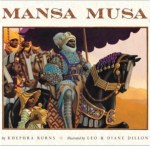


Mansa Musa: The Lion of Mali by Kephra Burns illustrated by Leo & Dianne Dillon

Standard
Mansa Musa: The Lion of Mali by Kephra Burns illustrated by Leo & Dianne Dillon

mansa8

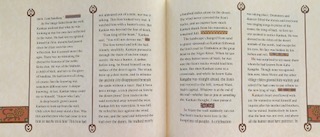
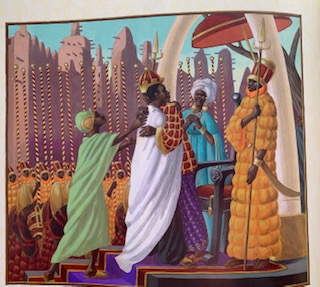
This beautiful work of historical fiction/folklore is both moving and visually breathtaking.  The 56 page book presents as a picture book, but with an AR 6.4 and the amount of text, it reads like a chapter book.  Thus, I’m going to review it as a chapter book, but keep in mind that it is hard bound, 11 x 9, horizontal and while there are frequent small story breaks, there are no chapter breaks.  

IMG_3078

SYNOPSIS:

There is little historical fact about Mansa Musa as a child, thus this story while rooted in fact about the time, about Mansa Musa as an adult, and about what is known regarding Mali and the Malinke and Tuareg tribes, is a work of imagined fiction.  The story begins with premonitions and dreams from Kankan Musa of the Kaba Kangaba tribe.  Kankan and his two brothers live with their mother, and do not know who their father was, a source of stress and teasing for the young boys.  Having just turned 14, Kankan is treated as an adult, but because he has yet proved himself as a hunter, he may sit with the adults, but not yet join their conversations.  Mali in the years after the great King Sundiata had passed away has begun to fade, but their wealth and hospitality still prospers in the desert. 

One day a desert nomad from the Tuareg tribe dressed in flowing blue robes appears and is welcomed by the village elders.  That night he regales stories about jinns, and the sea, and time spent in the desert, and fears he has for their King, when slave raiders tear through the night and kidnap Kankan.  When Kankan awakens days later, enslaved, the same mysterious man, Tariq al-Aya, again appears and buys him from the raiders.  Tariq vows to accompany Musa on his journey to learn who he is and the two spend seven years together learning about the desert, about the larger world, about themselves, in trial and test and challenges.

When Musa journeys back to his home, and Tariq disappears as mysteriously as he appeared, Musa must make himself known to the new Mansa of Mali and see if his wisdom and knowledge can ensure the success of Mali in the future.

IMG_3079

WHY I LIKE IT:

I’m not from Africa and my heart was cheering Musa on as if, my own families success was rooted in his growth and understanding of the world.  As a Muslim, I was proud to know of the success Mali found in Mansa Musa and the historical significance of his rule throughout time.   I wish there was more Islam in the book, his Hajj is well documented and thus tidbits of Mecca and his understanding of it is sprinkled through the story.  There is no talk about prayer or what Islam is, just that he is Muslim and that most of the villagers “had converted to Islam, but at the same time, they had not given up their traditional religious practices or their belief in the ancestors.”  It mentions at the end that he built mosques wherever he went, but prior to this it never mentions him spending any time in a mosque or worshiping in any way. 

I love that the story is told like all great stories, it makes you want to settle in and drink up the details and imagery and got lost in the pictures.  The author weaves in cultural phrases and descriptions, that hopefully readers can unravel from the context as there is not a glossary.  There is a map at the beginning, and author’s note at the end that reveals what is fact and what is fiction in the story.

IMG_3080

FLAGS:

None

IMG_3081

TOOLS FOR LEADING THE DISCUSSION:

This book should be in every school library and used in classrooms to learn about West Africa, cultures, 14th Century, Islamic history, culture, you name it.  I think this book would work wonderfully in home school environments, where the child could dictate how much to supplement, how much to cover, and the wisdom shared could really be understood.  This isn’t a book that most kids would pick up and read, they would need prodding and guidance, but be better for it.  

IMG_3082

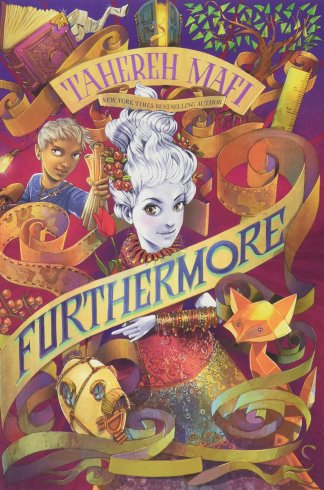
Furthermore by Tahereh Mafi

Standard
Furthermore by Tahereh Mafi

furthermore.jpg

I put off reading this book (I read the companion, Whichwood, first) because I had heard that the audio book was great and I wanted to listen to it with my kids.  Read by Bronson Pinchot, Cousin Balki from Perfect Strangers, the audio book takes 8 hours to cover the 401 page book, and it is delightful.  While Mafi’s circular repetitive world building, takes some slowing down to get used to, listening to it made the story move along when a physical book may have been abandoned.  An AR 5.5 the book is clean, but not gripping until about two-thirds of the way through.  As the main character grows in maturity, the story gets better and better, a mix between Alice and Wonderland and A Wrinkle in Time.  The book will require some determination to get through, but the journey will be worth it in the end.

SYNOPSIS:

Alice Alexis Queensmeadow is missing her father who left 3 years ago with only a ruler in his pocket, and hasn’t been seen or heard from since.  Her life is a bit messy as she is being homeschooled by a mother who she doesn’t really think likes her and thus spends most of her days outside eating flowers and trying to avoid wearing clothes.  Alice lives in a world of magic and color, but Alice has no color, at least not externally, her magic, which she must learn to accept is to add and manipulate color to the world, to anything and everything, except herself.  As a 12-year-old she must surrender her magic and be given a task to prove her place in her world.  She thinks her best gift is dance and her surrender goes terribly wrong.  With no where to go after her humiliating performance, she decides to take Oliver Newbanks up on his offer to go with him to help him on his task, he is 13 years old, and find her father.  Their unlikely assistance to one another is fraught with mistrust and bickering as they journey to a world Alice didn’t even know existed, Furthermore.

In the land of Furthermore, magic is used very differently then in Ferenwood, and on their journey where up is down and paper foxes rip limbs off, and Time is actually a person.  The two companions will have to learn to be honest with one another as well as themselves in order to survive, let alone to find Alice’s dad.  With the threat of death and being eaten constantly plaguing them, they journey from village to village where the rules are different and the laws of logic ever changing, with the hopes of completing the task and reuniting a family.

WHY I LIKE IT:

The details in the story are luscious and beautiful, and once you fall into it, you really do want to stay and look around a while.  There were times when listening to it, that the kids would get bored, yet now that we have finished it, all have mentioned that maybe we should get the book so they can reread parts again.  Mafi’s writing style is very thick that you don’t feel like you are making any progress, yet when you start to digest what you know, you realize in fact you have.  

At the beginning Alice is very annoying, and she stays that way for a while.  Her whiney nature isn’t sympathy evoking, but rather gets you irritated with Oliver as well, that he doesn’t just tell her stuff.  Both combined need to be bopped on the head.  Seriously, a bit of communication would really have taken out a lot of the unnecessary frustration the readers feel for the characters, and let the personal stuff they were hesitant to share with each other have more value.  It is a middle grades book, the empathy of understanding Alice and Oliver’s own fears and reticent in opening themselves up is a great lesson to explore through fictional characters, but because the kids have such poor communication skills about anything, their own fears lose potency.  The pacing of the story, is just as random as the villages they pass through as well, while they always seem in a rush, some of the places they stop they could chat at, rather than while they are running to save their lives, or while they are walking they could talk to give description through their eyes, to build up the characters, not just the world they are in.

Like in Whichwood, the narrator talks to the reader which is fun, and provides information that otherwise couldn’t be shared.  The characters names in each of the villages are clever and while the story could be mapped pretty straightforward, girl journeys to a new world to find her father with the help of a boy, who will become her friend, the twists and details, make the book memorable and worth the strain to get to the climax. 

I know this review sounds back and forth, and I think a lot of it stems from what you expect from the story before you begin.  I had tried to read the book and got a little discouraged, but I had a good feeling the audio book wouldn’t disappoint, so I plugged through and found myself enjoying and loving the story.  If you are expecting an action packed fully fleshed out rational story, you will be let down.  If you can just enjoy the whimsy on the surface and let the little tidbits of the larger story come at different times to complete the larger puzzle, you will love Alice and Oliver’s magical world and the fantastic journey that they go on.

FLAGS:

The book is clean.  A bit disturbing is that the people of Furthermore want to eat Alice and Oliver to absorb their magic.  It isn’t vulger, but it is silly that Alice doesn’t like wearing clothes.  While one could be nervous that Alice and Oliver develop a romantic relationship, rest assured they do not, they become friends and are 13 and 12 years old, so phew.

TOOLS FOR LEADING THE DISCUSSION:

I can see me doing this as a book club selection, although I’d probably lean more to Whichwood, in an Islamic School environment because of the names. I think young Either one though, I’m positive Muslim kids will enjoy seeing a hijab wearing Muslimah pictured on the back flap and seeing that she can write a mainstream engaging fantasy novel about whatever she likes.

Author’s website: http://www.taherehbooks.com/book/furthermore/