Tag Archives: goat

Hope Ablaze by Sarah Mughal Rana

Standard
Hope Ablaze by Sarah Mughal Rana

This young adult book is an intense raw unflinching read, containing  incarceration, assault, politics, Islamophobia, immigrant pressure, and loss throughout the 384 pages that mix poetry and traditional writing.  At times the book is incredibly hard to put down as the commentary on two party politics and Muslims in America is articulated in a way that transcends the fictional constrains and affirms reality.  But unfortunately, it took me a long time to complete the book, because when I did put it down, I didn’t feel that relentless urge to pick it up and see what happens next.  I had been alerted to the fact that there were elements of magical realism, but even with that knowledge, I still felt it misplaced, and truthfully, unnecessary.  The pacing was inconsistent, and many points unnecessarily forced.  It often felt the author was simply trying too hard to tell the story and make sure the reader got all the messages intended.  As a result many characters are flat, many plot holes exist, and the reader is left wishing things were done just a little bit different to make the book what it could have been, not what it is.  I know it is a debut, so I’m not going to be overly detailed in my harshness, I am fairly positive I will read anything this author writes down the road, I took pictures and shared passages that I loved on my socials.  The book is good, it just really could have been great.

SYNOPSIS:

Nida is a poet, her uncle is a poet, and her uncle is in prison.  When Nida is frisked, her hijab removed by a political candidate’s team as she makes salat in a public park, Nida is forced to find her words, her voice, and her place in an unkind Islamophobic world.  High school friendships, immigrant Muslim community pressures and idiosyncrasies persist for Nida as she navigates media manipulation, injustice, slander, and political talking points.  Life was already complicated with her father’s departure, her maternal uncle’s wrongful incarceration, and the goats that her mother brings home to sacrifice, but with the support of the Poet’s Block, her Muslim community, family, and the thread tied to her family through generations, she will find she isn’t alone, and she has support, she just has to take a stand.

WHY I LIKE IT:

I love how much mirrors contemporary reality, the MIST competition, the politics, the media, the dirtiness of it all. I also like that it has a fair amount of humor, the Islamic accuracy, friends getting called out for boys and girls texting each other.  Overall though, it just felt so forced. I think some subtly and nuance and undercurrents would have given the reader the ability to connect the dots for themselves, so the book would have lingered and taken up space long after the last page was read.  It is hard to write a book about how great a writer is, how powerful poems are, so at times it really felt spoon fed that this is powerful, here read it, see it was powerful.  Additionally, I think when the author did try for subtlety, it just came across as lacking.  I still don’t fully understand any of the side characters, their relationships, or their purpose.  From the betrayal of a school friend, to the new friend from MIST, to the little brother, to the friend and his uncle who is imprisoned, there ultimately lacked a lot of emotional heart for minor characters, who remained stagnant, while passionately emphasizing issues at their expense.

The OWN voice Islamic rep is so spot on even if the evil eye passages seemed amplified and repetitive. Islam is centered, it is unapologetic, it is the characters identity, comfort, and soul.   Only one point really stood out as erroneous, but I read a digital ARC so it could have been fixed or it could have been a spacing issue since it was in a poem, but it has sajood in janazah, and I’m really hoping the final book will not have it wrong, as there is no sajood in janazah.

FLAGS:

Assault, frisking, incarceration, death, profanity (not a lot, damn, hell, shit), Islamophobia, racism, systemic abuse, lying, talk of terrorism, stereotypes, gaslighting.

TOOLS FOR LEADING THE DISCUSSION:
I’m on the fence about using this book for a book club read.  I love the Pakistani culture, the Islam, the contemporary relevance, and the political commentary.  I think it would have actually more success in a guided or required reading situation with teens than it would as a pleasure read.  Undoubtedly I will order a copy to put on my library shelf, but I might test it out a bit on a few readers to see how their thoughts before I present it as a book club selection or not.
The Kingdom Over the Sea by Zohra Nabi

Standard
The Kingdom Over the Sea by Zohra Nabi

kigdom

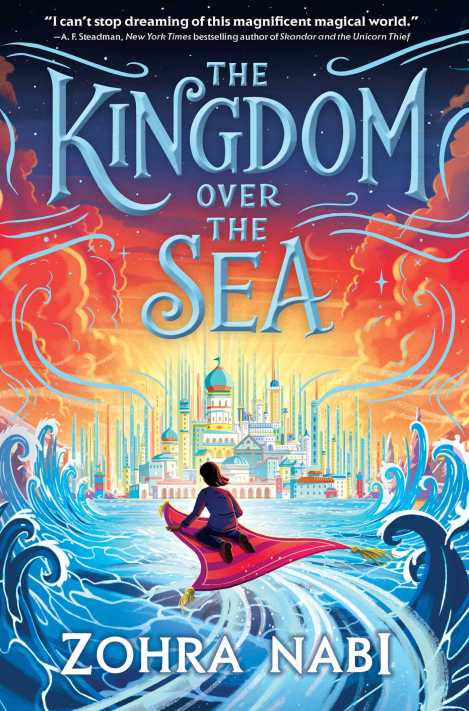
This 336 page middle grade fantasy book had a lot of promise for me, but ultimately fell a little flat.  The protagonist was likeable, there was emotion, the story was compelling, and I know it is widely said that debut novels tend to be a little weak or be underdeveloped or having pacing problems, yet I hesitate these days to use this as an excuse.  I’ve been around the industry a few years and it seems many author’s debut novel, is not, in fact, the first book they’ve written or even the first book they’ve “sold.” Books are written and finalized years before they are released for some genres particularly of late, so I’m trying not to let myself get caught up in the author’s writing journey (I’m sure I’m all sorts of wrong about what I think it would be anyway), and just review the book in front of me. This book has no religion, and I don’t know if the author identifies as Muslim.  There are a hodgepodge of Arab and Desi cultural references in the characters’ names, and in the sprinkling in of salwar qamis, abaya, head scarf, sambusak, and there is a ma’a salama at one point along with the presence of jinn (not religiously referenced). There is also mention of medicinal wine, magic, a lady who has a crush on another lady in her youth, music, and dancing. The book held my interest as I wanted to see how it unraveled, and I recognize that there is a book two, so some of my thoughts might be premature, but I struggled with the premise of the protagonist trying to understand the journey her deceased mother has sent her on, and how the person she was supposed to find for the answers simply won’t talk, even though the two are living together.  It made the story really drag in places and seem underdeveloped.  The world building, the backstories, the adventure at hand, really is imaginative, but the development of the relationships in the story are absolutely non existent, and the book overall suffers because of it. Also the ease in which rising action is resolved is often the kids just throwing an idea out and it being right.  I read and review through a critical lens and many recent middle grade fantasy books have been absolutely incredible, perhaps it isn’t fair to compare, but this book just came up short for me in developing memorable characters and plot, even though all the elements were present, capitalizing on bringing it all together stayed just out of reach unfortunately.

SYNOPSIS:

Yara’s mother has died and when she finds a letter with instructions of what to do and where to go should this moment arrive, she decides to dodge her social worker and journey to a world of magic across the sea.  Unsure of her own background, she thinks she might be Iraqi, but doesn’t speak Arabic, she longs to find a place to belong, and when she arrives in Zehaira and hears the language of her mother, she is hopeful that this Leyla Khatoun, who lives in the third to last house on Istehar Way, will provide her with answers. But alas Leyla is not there, the Sultan’s alchemists are, and Yara is now on the run in a foreign land.  Help finds her and with a little magic she finds Leyla.  Leyla begrudgingly takes her in, but refuses her any insight into her past, her relationship with her mother, or why the letter directed Yara to her.  As the alchemists poison the sorcerers, Leyla and some other kids (friends?) have to find a way to save the settlement and magic in the land.

WHY I LIKE IT:

Yara as a character is likeable, she is plucky, resourceful, determined, and despite her circumstance does not want or need pity or handouts.  She advocates for animals, the poor, is a grassroots organizer, and unapologetic in how she carries herself.  I love that she isn’t whiney or helpless, and that she trusts herself to problem solve and isn’t afraid to think outside the box, while maintaining her kindness and appreciation for those around her.

As someone who doesn’t like Alice in Wonderland type stories, this book grounded the world building in an easily consumable way, so even though it is Yara leaving the UK and stepping into a new world, the functioning of the new world didn’t feel random or surprising.  While this was beneficial for someone like me, it made the focus of the story more on the characters’ relationships in enhancing the plot, and the book wasn’t strong in showing those connections.  Yara meets a map maker for a moment and a cat, and months later recalls the cat and the map maker by name and face.  A boy, Rafi, who is also studying magic and Yara don’t get along, yet are friends because it says so, the book doesn’t show us their bond.  Rafi meets some great uncle and the great uncle is painfully underdeveloped (along with his “friend”) and the tangent weak in reinforcing the major climax. The relationship between Yara and Leyla is the center of the story and so glossed over, there is no tangible connection, or cathartic release when details emerge, it was very disappointing to say the least. Yara and Ajal, the jinn, what is that relationship even, she frees him à la Aladdin freeing the Genie, but they are friends, not friends, he looks out for her, but doesn’t like her, the telling and the showing don’t align.  Even Yara’s relationship with the settlement and the inhabitants is disconnected from the plot of saving magic.  The climax is weak because we, the reader, don’t feel any connection to any magical folk.  The emotion of the mother dying at the beginning and the slight retrospection (I’m not going to spoil it) of the mother’s love at the end, was developed and made me invested in Yara, that same energy did not present itself, sadly, in any other relationships in the book.


FLAGS:

Death, loss, poison, imprisonment, magic, mention of medicinal wine, one line mention of a female character liking another female character as more than a friend, dancing, singing, jinn, torture, male and female friendships, destruction, lying, sneaking.

TOOLS FOR LEADING THE DISCUSSION:

I wouldn’t use this as a book club selection and wouldn’t go out of my way to shelve it in the school library or classroom library.  I will probably read the second book though and see where the series goes and reevaluate. I will also probably read future works from the author as the sparks of good story telling and writing definitely show promise for the author even though this particularly book wasn’t “magical” for me.