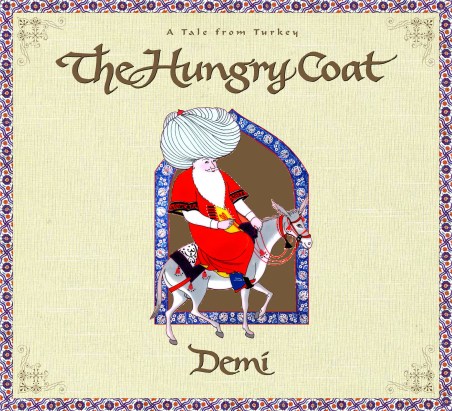
It really bothered me that I didn’t love the version I read of The Parrot and the Turkey about Nasreddin Hodja, especially after finding out how entwined he is in Turkish culture, and reading some of his tales online. So, when I found that Demi had also rewritten and illustrated a tale from his collection I was anxious to check it out.
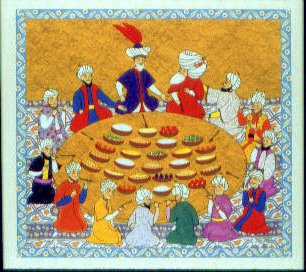
The Hungry Coat is a charming story and Demi does a great job of bringing it to life with her pictures and storytelling abilities. The book is 36 pages and a 4.1 on AR. The text isn’t overwhelming in volume, but to read it definitely requires a bit of an older child’s vocabulary. Words like caravansary, hostel, banquet, frisky, and commotion are scattered through out. However, to listen to the story and to understand the message Nasrettin Hoca (an alternate spelling) is conveying, is easily enjoyed by children four and up. The story flows very smoothly and the catch line of “Eat, coat! Eat!” makes the story absolutely delightful.

Nasrettin Hoca always keeps an apple in his pocket for any goats he might pass while he is out and about. One day he helps round-up a goat that has gotten lost, and in all the commotion had become quite a mess and lost too much time to go home and change his clothes before heading to a friend’s house for dinner. Deciding to go in his patchy, smelly clothes, Nasrettin soon finds that none at the dinner party will sit by him, or even sit facing him. He slips out quietly from the gathering and has an idea. He goes home and preens himself, and returns to the party where he is greeted with attention and kindness. At dinner he begins placing the food in his coat, rather than eating it. Each time he opens his coat he commands it to eat. After he fills his coat he pats his belly to the bemusement of all around him as they ask him what he is doing. He makes his point that when he came in his old coat he wasn’t fed, but when he came dressed so beautifully he was, and thus clearly the coat was invited to dinner, not him. Everyone cheered and learned the lesson.
“A coat may be fine, but a coat does not make a man.”


The illustrations are rich and detailed, but I did find myself a little put off when Nasrettin seemed to go from looking like an old little man, to being very effeminate. The inconsistency bothered me a bit, which surprised me for a Demi illustration. Also, it is worth noting that there is mention of wine in the story, that many may find off for a children’s book, particularly one about Muslims (Nasrettin was an Imam and a Dervish, so he may have drunk, I’m just saying it surprised me). The last two pages of the book are an afterword about Nasrettin Hoca in real life and the influence of his folk tales and lessons.
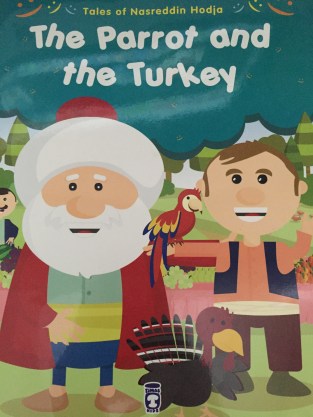 I ordered this book a while ago online. There is a whole series of Nasreddin Hodja, so I picked a title at random. I read it when it arrived and the story seemed to wander more than my attention span could follow. So naturally, I had my children read it, and they said it seemed funny, but they didn’t understand it. I glanced through it again and figured maybe it was one of those beloved cultural characters that just lost some of their charm in translation. In this case, Nasreddin Hodja is a folktale type character born in the 13th century from Konya, Turkey, who is the star of short stories that teach a point in a silly way. The opening page tells a bit about him and what you can hope to learn in the story, but it didn’t help understand why the book was so fragmented.


 Islamic School Librarian