EDIT: I have been made aware that some/many of the included authors in this anthology have chosen to stay silent or “both side” the ongoing genocide in Palestine. Please be aware and be intentional and informed with your support

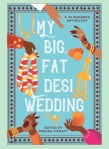
This 288 page YA short story anthology features eight stories of Desi weddings threaded together by an auntie with a bob haircut and a mole on her lip that appears and disappears into stories with magical realism, Tamil Brahman vampires, competing food dynasties, high school debate rivals, gorgeous clothes, delicious food, and sparks of romance. Usually collections are hit or miss with writing quality and interest, but I found this collection enjoyable from start to finish. My only real critique is that of the YA label and as a result some stories read more juvenile and at least one a bit more mature. As a whole, the book, particularly for the genre, is fairly clean. It is YA, it is romance, there are a lot of Muslim characters, with five of the authors being Muslim, but I would not classify any of the relationships or stories as halal. That being said, I think mature teens 16 and up won’t find anything too alarming in the pages. There is music and dancing, close male female friends, secret relationships, a few kisses, some dances and hand holds, and a few that mention sex, condoms, and LGBTQ+ possibilities in passing, but most focus on weddings, culture, parental relationships, strong women, caste ideology, and hinting at happy every afters. Many of the stories are simply set during a wedding or wedding prep, others are the bride or groom themselves, I don’t have a favorite or even a least favorite, as each has its own flavor, writing style, and focus.
SYNOPSIS:
Framed from an Auntie embarking on the wedding season, the short stories begin and follow one after another until the Auntie returns to conclude the book.
The Disaster Wedding by Prerna Pickett: In a family where the words the females speak can come to fruition, an erroneous slip, claiming that her sister’s wedding will be a disaster brings on the challenges for the enemies to lovers side characters trying to not upset the marital couples multicultural Indian/American dream wedding.
A Cynic at a Shaadi by Aamna Qureshi follows a young Muslim girl nursing her broken heart from a recent breakup with her secret boyfriend. Set during her cousins wedding, an upbeat optimistic boy makes her smile and gives her heart hope.
Sehra by Syed Masood involves a Muslim marrying a non Muslim girl that has the family refusing to attend. The groom-to-be’s brother is torn and wants to attend, but he never goes against his parents. His best friend who has grown up with the family and is facing her own community othering because of her “Mickey Mouse” hijab style, is planning to go, and together the two friends help wrap the groom’s turban.
Fates Favorites by Tashie Bhuiyan features magical realism with the words of soul mates appearing on skin. The words appear and disappear sometimes unseen and possibly even as a result of one’s subconscious, thus the couples don’t always find one another, but when they do, the relationships can be magical.
The Wedding Biryani by Noreen Mughees is possibly the most religious of the short stories with high school debate rivals finding themselves cooking at the masjid for a couple that doesn’t have a family to celebrate the marriage. Themes of losing a parent to death and simply leaving are present, as well as some internal reflection of boundaries, Allah swt, and body image. The conclusion is the teens meeting up to dance.
A Confluence of Fates felt like the longest short story, and while many Zoroastrians it notes did come to India, the story focuses on Iranian Zoroastrian culture. It is almost a story within a story as a couple gets a second chance at their relationship with the backdrop of a marriage play during the wedding unfolding in the background.
A Wedding Recipe for Disaster by Sarah Mughal Rana has competing family businesses: one Punjabi and the other of Pashtun culture, coming to a head when the offspring of the rival companies decide at the girl’s wedding to someone else, that they should be together. With vibes of a Romeo and Juliet style family feud, the happy ending has readers craving achar and contemplating racism within the community.
And finally, A Very Bloody Kalyanam By Anahita Karthik goes gothic with a Tamil Brahmin vampire wedding occurring when offspring from two enemy cults imprint on each other. This story is more mature with talk of sex, but has an emotional forgiving between the bride and her parents that makes the vampires lovable.

FLAGS:
It focuses on romance, and none of the stories are “halal.” Music, relationships, boy girl friendships, Talk of sex, hints at LGBTQ+ identities, mention of condoms, vampires, magic, magical realism.
TOOLS FOR LEADING THE DISCUSSION:
Probably not a book to seek out for an Islamic school shelf, high school can probably handle it and understand it is not halal.


 Islamic School Librarian