Tag Archives: rebellion

Fledgling: The Keepers Records of Revelation by S.K. Ali

Standard
Fledgling: The Keepers Records of Revelation by S.K. Ali

fledgling


This 544 page science fiction dystopian fantasy is in my humble opinion S.K. Ali’s best work, and that is saying something.  A lot actually, especially considering I am a Muslim book reviewer and there is no Islam featured in the book. As my author friend Shifa Safadi articulately put it, “it is Muslim coded,” a much more succinct term to describe my rambling thoughts of how Islam seems to be just below the surface, never breaking through, but making the book seem OWN voice and authentic. The book is for ages 14 and up and stays fairly clean, allowing for complete immersion in to the story, the world, the future, and the characters’ lives, without any fear that something drastically detailed and haram, would suddenly appear and pull me out of the flow of the story.  There is a bride market where women can be bought and mention of lovers being taken, but it isn’t normalized, it is for a purpose, and the acts are not detailed.  From start to finish this book is a gift to readers.  The writing quality is superb. The book is told from nine (?) points of view,  and I never once felt the need to flip back to see who was speaking, as each voice is clear and unique. The twists, the heartache, the triumph is all palpable and griping.  The mix of genres works because the characters have multitudes and incredible storytelling made the lengthy book, not nearly long enough. I can’t wait for the second part of the duology, from the Underground to Upper Earth, the world was not one I left willingly, and I look forward to returning for the conclusion.

SYNOPSIS:

I really am not sure how to summarize the book without giving much away, I’m actually surprised myself that I’m writing a full review for a book by a Muslim author with no Islam present, so here we are.  As with all S.K. Ali books, this book starts with a possible “romantic” relationship, in this case though, it is an arranged couple meeting, and it isn’t going well.  But where comedy and faith might normally then enter the story, this book, veers from her norm, drastically.  Set in a dystopian future where scalplinks and mind control allow the “enlightened” to live a vastly different life than those on Lower Earth who’s resources have been plundered, the union is to be between Raisa, of Upper Earth, and Lein the crown prince of Lower Earth as an attempt at achieving peace.  Politics, greed, loyalties, love, all add in to the mix of a rebellion and the hope that comes from the Fledgling.

WHY I LIKE IT:

The book starts with a character list which is an incredible tool for readers as the first half of the book is forced to simultaneously balances character development, world building, and plot progression with a lot of moving parts. The style of memory records, announcements, current events, flashbacks, and changing povs keep the book’s pacing moving, but it really took about until the midpoint for me to be unable to put the book down. What at times early on could be perceived as cumbersome, became truly what makes the book stand out.  To see each character through their own eyes, through their own lived experiences, and to see their thoughts and feelings grow and change, really pulls you in and brings the humanity to life in a book that could have become more plot than character. It also emotionally ties you to the characters and the twists and revelations and loss, hurt a little more than I would have expected as days later I am unable to stop my head from returning to parts of the story that still have a hold on me.

FLAGS:

Death, torture, abuse, killing, murder, hunting, manipulation, lying, a love scene between a coded married couple, oppression, colonization, bride markets, misogyny, cheating, it is YA dystopian, fantasy, sci fi, romance, adventure, so there is some grit at times, but not for sensational vulgarity, it is always for a point and not taken lightly.

TOOLS FOR LEADING THE DISCUSSION:

This book would be incredible to read in a high school class: Islamic school, home school, public school, private school, you name it.  There is so much to discuss about colonization, oppression, rebellions, politics, and yet none of it comes at the expense of good story telling.  I would love to hear students discuss their favorite characters, opine on their motivations, and argue right vs wrong with citings from the text.  No two people would feel the same, I would almost guarantee it.

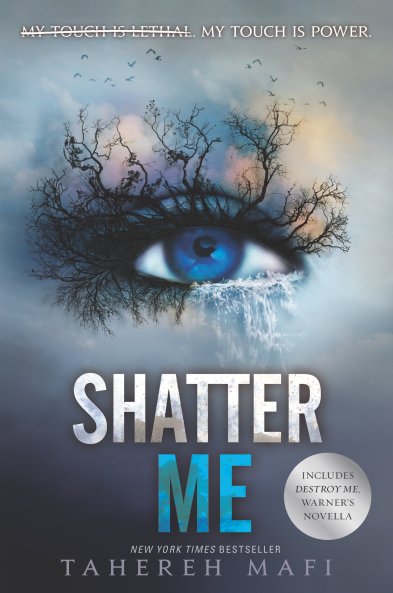
Shatter Me by Tahereh Mafi

Standard
Shatter Me by Tahereh Mafi

shatter

In many ways this 338 page dystopian YA fiction book focuses more on romance than the super human powers the 17 year old protagonist has and the role she will play in the resistance.  That isn’t to say the book is bad, just that it isn’t as high action, or reform-a-broken-world, or even use-my-super-powers-to-save-myself-and-those-around-me as I had hoped. It is more a lot of self loathing, desire, and anger.  That being said, I am on the fence about reading the rest of the series, as this is the start of a six book series, with two “half” novellas interjected in and being told from other characters’ perspectives.  If this was a show pilot, however, I would let Netflix automatically start the next episode until I had binge watched the entire season, not necessarily because the story is great, or the characters amazing, or the writing stellar, but because it is easy and fun and you really want to suspend belief and know who all these attractive mutated teens running a broken world are, and yes you will roll your eyes at the syrupy sweet lust filled pages, but it is YA so maybe I’m just overly cynical and 15 year olds and up will enjoy it.  It is an AR 4.3, but the language, violence, and romantic build ups should not be read by 4th graders.

SYNOPSIS:

The book starts with Juliette counting how many days she has been locked up in a cell, 264, void of human interaction of any sort and hinting at the reason her parents feared her and turned her in.  She is then joined by a male cellmate, Adam, one she slowly realizes she remembers from her youth and is in love with.  As he asks her questions we learn a bit about her power and the state of the world.  Juliette can kill people with her touch and apparently has killed someone, a child.  Her parents, along with everyone else, have always feared her, and not being hugged or touched her whole life has definitely been a painful existence for her.  Adam is a soldier and can touch her, he is also planted to learn about her as part of his job.  Warner, another teen, is in charge of a soldiers in the Reestablishment and has been following Juliette for a long time trying to see how they can weaponize her and use her for their cause.  Adam was playing a role, and now Juliette will have to play one in a world where the food is fake, the clouds the wrong color, and artifacts of culture and life before it all fell apart are destroyed and deemed illegal.  Along the way she will have to see the world in shades of gray and be willing to forgive and understand that people are not just for or against the way things, are, that sometimes you just have to do things to survive and protect the ones you love.

WHY I LIKE IT:

With all the talk of Iran in the news, I felt compelled to read a book with a Persian character, or at least by a Persian author, so I revisited the works of Iranian-American Muslim Tahereh Mafi.  The book reminds me of a Bollywood drama from the 90s where the hero and heroine do everything suggestive, except kiss, in this book they do a lot, but I guess don’t quite cross a line.  The scenes with Adam and Juliette are too much at times, where the story building about her understanding herself, her world, and what her powers can be, too little. The stage however, is set for the book and characters to grow in the series and with that optimism of knowing that the story stretches on, I have to hope the twists and turns make for a more interesting ride than this first book presents.  Most of the drama is already spelled out on the back cover, she can kill people just by touching them, she wrestles with seeing herself as a monster, or as being more than human.  It really doesn’t start getting good until she finds others like her, but then she is bored of them and the book ends.  The book has a huge following, so much like perhaps the Twilight series, maybe I’m just too cynical, and not in the target demographic, or maybe I need to keep reading.

FLAGS:

There is violence, *SPOILER* Juliette accidentally kills a child.  There is language, there is suggestive talk, there are romantic passages with kissing and touching.  For a book about a character who can’t touch, I feel like the majority of the book is about her touching and being touched.

TOOLS FOR LEADING THE DISCUSSION:

I wouldn’t do this as a book club, because I feel like it really is just a book setting the stage for what more is to come and because it ends so abruptly it feels almost like a teaser, yes a 300+ page teaser.  I was hoping that I could at least suggest it to readers of Hunger Games, City of Ember, The Giver, etc., but I don’t think it spends enough time on the crisis of the world at hand, and the adjustments made by a select few to appeal to the same readers.  It really is a romance, at least thus far, and the destruction of life and the environment just a back drop for their storyline.

Internment by Samira Ahmed

Standard
Internment by Samira Ahmed

internment.jpg

The premise of this book is amazing, the writing and execution of it, unfortunately, falls flat.  The failure to set the stage, develop characters the reader cares about, and create a world in the near future that is both riveting and horrifying doesn’t come through in the book’s 387 pages written on an AR 4.7, but meant for high school aged readers grade nine and up.

SYNOPSIS:

Indian-American Layla Amin is 17 and since the census that her family honestly filled out and identified themselves as Muslim, their life under the new president has been shattered to say the least.  Her poet father lost his job as a professor, her chiropractic mother has lost numerous patients, Layla has left high school and they all live in fear.  With curfews and people they’ve known their whole lives turning on them openly, the book opens with Layla chooses to sneak off to see her Yemeni Jewish boyfriend, David after curfew.  The next day suits arrive to take the family to an internment camp in the desert, near the old Manzanar detention camp used to house Japanese Americans during WWII.

The new camp, Mobius, is the first one to house Muslims and the first of many slated to be built.  The detainees are divided by ethnic background, Layla’s FEMA trailer is in a block of other Desi families, Arabs a few blocks away, LatinX, converts, etc., all given minders to control them from within their own community.  As Layla whines about her cell phone being taken away and how much she misses David, a guard, Jake, takes pity on her and regularly risks his own position and Layla’s, as he sneaks her access to phones, gets her burner cell phones and even sneaks David in so the two can make out.  Somewhere along the way it seems Jake and Layla develop feelings for each other, but it really isn’t explored.  Layla makes friends and somehow becomes a revolution leader with her writing notes about life on the inside and having Jake and David get them to the media.

Those that speak out against their situation or complain, disappear and never return.  The Director of Mobius, ensures it.  In their refusal to eat dinner one night, and their protest at the front gate in front of protestors and the media, eventually Layla gets taken, but with her friendly guards, she finds she isn’t completely alone and that she just needs to be brave a little longer, stand up at the right time and get incredibly lucky to be successful in the revolt.

WHY I LIKE IT:

The President in the book is undoubtedly Trump, and I love the passages that reflect how the fictitious America didn’t become racist overnight, but that the leadership allowing it, ignited the ugliness that already existed.  It mentions making America great again and really sets the foundation of a simple “what if” that really could happen very easily.

The parts that struggle are the story elements, I really didn’t find myself cheering or even liking Layla, I didn’t find her charismatic or interesting, she was really whiney and flat to me.  I didn’t care one bit about her and David’s relationship, it seemed forced and completely not necessary.  A friend or concerned neighbor might have been more hope inspiring than a high school boyfriend she is brooding over to save her.  Her sneaking out and sneaking him in, all seemed selfish and juvenile for a character who in other arenas seemed pretty mature and level headed.  The disconnect is pretty prominent and I really cringed at all of the passages involving the two of them.

There are flash backs to life before the new President, but it isn’t engaging and doesn’t really highlight how horrific life is now, because the lack of character development and world building, everything seems like it has to be said, not shown.  Random characters at the camp would show up and then disappear, and we knew nothing about them, so there was no emotional connection or attachment to what happens to them, it really had so much potential to have heart and fear and insanity and it just doesn’t.

Layla identifies as Muslim, and lovingly recalls ayats and duas of her grandmother, but the family firmly believes that “there is no compulsion in religion” and thus doesn’t hide who they are, but don’t visibly display it in their clothing, or actions much either.  They don’t have a problem with their daughter having a boyfriend and they support it.  Layla and her mom don’t cover, but Layla does show massive respect for the Muslims that do.  Layla’s parents seem to pray, Layla doesn’t, but she doesn’t seem against it.

FLAGS:

Lots of kissing between Layla and David, a gay couple that disappears in the camp, flirting between various other characters, violence, oppression, language, death, beatings.

TOOLS FOR LEADING THE DISCUSSION:

I actually feel like this could work as a book club book because the discussion would be so great.  Yes, there are flags, but the relationship stuff is so annoying and awkward, I don’t think any kids will find it titilating or compelling at all. The writing is subpar, but the issues brought forth are important, and the students would have infinitely better plot lines for the characters that I think could make the books premise reach closer to its potential.

A letter from the Author: https://www.hachettebookgroup.com/articles/a-letter-from-samira-ahmed-author-of-internment/

Book Club Guide:https://www.hachettebookgroup.com/wp-content/uploads/2018/07/InternmentNovlBookClubGuide.pdf

Review podcast: https://teachnouvelle.com/internment-by-samira-ahmed/

There is a ton online, just google it and Happy Reading