Tag Archives: War

Sitti’s Secrets by Naomi Shihab Nye illustrated by Nancy Carpenter

Standard
Sitti’s Secrets by Naomi Shihab Nye illustrated by Nancy Carpenter

sitti

Sitti’s Secret was published in 1994 and given the events of the week, I’d say it is more relevant today than it was when written.  And if by some chance the events of the week haven’t affected your children, then the poetry and soul of the book still makes it an amazingly powerful story.

Mona travels from America to Palestine to visit her grandma, her Sitti.  Without the ease of speaking the same language, Sitti and Mona learn to communicate and build a tight bond cut too short by a vacation coming to an end.  When Mona returns she sees the news and writes a letter to the President, telling her Sitti’s secrets, telling him they would be great friends, and telling him they only want peace.

Truly Nye is a poet, even in Turtle of Oman her words transport you to a place where time slows down and the connection between a child and a grandparent make you nostalgically yearn for a simpler time.  Having spent my summer’s abroad visiting my grandma I could relate to so much of this book and truly had to still my heart.  The little things, like examining your grandma’s hand, or hanging out laundry, or brushing her hair. Even that dreaded final hug as you prepare to leave,  I could relate and it was enchanting.

No where in the book does it mention the Middle East or Islam, only at the beginning does she hint at it by dedicating the book to her 105 -year-old Sitti in Palestine, it mentions that she speaks Arabic and a few words are sprinkled in. And the Grandma does wear a scarf.  Other than that the book is by and large not political.  If you know that Nye has a Palestinian father and American mother and often writes semi auto biographical pieces, the book can take a bit of a different role to the reader.  Many reviews criticize the activism upon her return (the letter to the President), and found it disjointed to the rest of the story.  But in today’s climate I found it empowering and hopeful.  The world will only find peace when we put a face to those that are different to us, and even children can change our stereotypes.  I love that my children are seeing that they can make a change in the world today, and to see it reinforced in literature was gratifying.

The book is 32 pages and written on an AR 3.9 level.  The illustrations are beautiful.  They bring the words to life in a tender and heartfelt way.  The detail is subtle but deep and i have found myself thumbing back through the pages to get lost in the illustrations multiple times.  I think the book works on different levels for different age groups.  If you have a family that has to overcome great distances to be together, even younger readers will be able to identify with the story’s tenderness.  If you are in 3rd-6th grade and are aware of what is happening in the world you will be inspired.  If you just are looking for a sweet book, subhanAllah it manages to fulfill that category too.

The Red Pencil by Andrea Davis Pinkney illustrated by Shane W. Evans

Standard

The Red Pencil.jpg

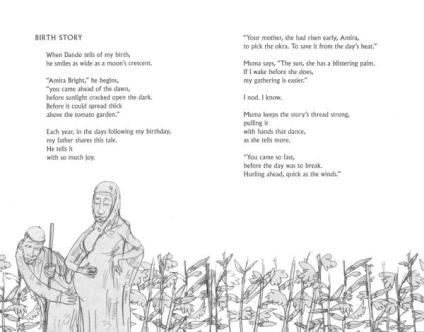
I didn’t realize the book was written in prose until I opened it up to read, and immediately taken-aback I rechecked the AR level and sure enough, this 309 page book that is written in prose and covers the genocide in Darfur, is written on a 4.2 level. And it is amazing. I forced myself to stop reading at one point so as to not rush the depth and soul of the simple words from being lost in haste.  It is truly, in my opinion, a beautifully remarkable feat to convey such horrific atrocities with such hope and integrity to young adults in a palatable and inspiring way.

“Allah is the light,” he says.

I ask,

“How do you find Allah’s light?”

Old Anwar says,

“Take the path that shines the brightest.”

SUMMARY:

Amira’s life on her family’s farm is by no means easy, but she has loving parents, a little sister, her beloved sheep, and a dream of going to school.  Her father advocates for her, but her mother, steeped in tradition, sees education only as a waste of time.  The illustrations and sparse words manage to convey fairly solid understanding of Amira’s life, optimism, and relationships with those closest to her.  Although warned of the dangers the Janjaweed could cause, Amira remains fairly unconcerned about the mounting political unrest around her, until it is too late.  When death and the destruction of her home force the surviving members of her family and neighbors to seek refuge in a camp many miles away, the reader sees how truly horrific her experiences have been.  She refuses to speak or rather cannot, when a chance encounter with an aid worker brings her the prospect of getting her voice back, through the empowerment of a red pencil.  With restored determination she convinces an elder neighbor to teach her, but it is not enough for Amira Bright.  Her sparrow needs to soar free.

WHY I LIKE IT:

You expect a book written in verse to have a lot of imagery and symbolism, and The Red Pencil does a good job of balancing the story and the description, to keep the book on track.  The linear story line remains focused on telling the story at hand, making it attainable for elementary and middle school children.  The Darfur conflict is complicated at best, and using verse to convey it from a young girl’s voice allows a lot of the politics and dirtiness of war to be side-stepped without dismissing it.  Amira’s optimism and hope is at times naive, but more as a reflection of her personality then out of ignorance. She sees things, and feels things, and must deal with things, no child should, but her spirit shines through and keeps the book from being depressing, while still being sad.

Today the red pencil does more

than beg for my hand.

It makes me a promise.

It tells me to try.

The characters are Muslim and they rely on Allah, and pray, yet Amira’s thirst for knowledge includes that of learning the Koran (Qur’an) as that knowledge too, has not been readily available to her  There is a lot to discuss in the book, both what is written and what the reader brings to it.  I look forward to teaching the book, and re-reading it once again to savor in the rich images.

Here,

Muma stoops.

Here,

she has nothing to reach for.

FLAGS:

Their is violence when the Janjaweed attack her family.  But I think it is conveyed in a manner suitable for 3rd grade and up.  It is not celebrated or glorified, it is traumatic and has repercussions that are respectfully conveyed.  There is also mention of a child bride, but not in so many words, that in all honesty I doubt most young readers will be as bothered by it as perhaps they should.

TOOLS FOR LEADING THE DISCUSSION:

There is a discussion guide in the back of the book along with an Author’s Note, Acknowledgements, Glossary/Pronunciation Guide, Character/Location Pronunciations, and Important Terms that Appear in the Book.

An Educators Guide: http://media.hdp.hbgusa.com/titles/assets/reading_group_guide/9780316247801/EG_9780316247801.pdf

A study guide and quiz: http://www.bookrags.com/studyguide-the-red-pencil/free-quiz.html#gsc.tab=0

The Red Pencil 1