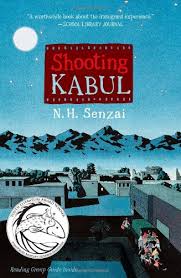
 Shooting Kabul is another book that I just re-read to see if it would be a good fit for our 5th – 8th grade Book Club, and I think it will be a perfect fit, so much in fact that i just ordered enough copies to use for our next selection, inshaAllah. It has an AR level of 5.4, perfect for our age group, and depending on the copy and extra glossary, book discussion and extra pages, about 262 pages of story. I haven’t decided if I will have everyone read it, or divide the group on gender lines, have the boys read Shooting Kabul, and the girls read When Wings Expand. Senzai’s book is definitely not a “boy” book, but knowing the boys in the school, and how tender-hearted they all seem to be to their little sisters and the preschool students, I may divide the genders so they feel a bit more free in discussing. Not sure yet, will keep you posted.
SYNOPSIS:
Told from the 11-year-old perspective of Fadi, the reader is taken on an adventure that is both heart-wrenching and plausible. Fadi’s family makes the decision to leave Afghanistan as the Taliban’s power grows and threatens the family. In their covert escape, Fadi’s six-year-old sister Mariam is left behind and the family must continue on to America, obviously all completely destroyed by their loss. Once in California the family struggles with fitting in, making their way, and living through September 11th and the repercussions of the aftermath on Muslims. Fadi turns to photography and finds a niche, as well as hope that perhaps he can win the grand prize in a photography contest that will take him to India, that much closer to where his sister might be found.
WHY I LIKE IT:
The book, while political does not make it a black and white issue, like some YA novels dealing with Afghanistan. Similarly while September 11, is a huge incident in the book, it is presented from the perspective of how it makes Fadi feel, and the bullying that comes with it, again keeping the terror a bit at arms length and consumable by a younger audience. Being that the book is loosely based on the Author’s husband, and his family’s escape I think it would be permissible to say that the account and portrayal of life in Kabul and immigrating to America is realistic. As a result, the authenticity of Islam is also kept. The characters are Muslim and it defines them, it gives the character’s depth, but is not forced upon the reader. Fadi goes to Jummah, he ponders points about the khutbah (sermon), he and his father discuss how the Taliban uses Islam to their advantage, not in the way the Qur’an and Hadith present it. The reader, either Muslim or non, I doubt would be overwhelmed by the religious presentation, it simply shows that aspect of the character. Fadi is not questioning his faith, nor is it being forced on him, it is simply who he is, and something that defines him, something I think will be identifiable to my students and allow them to imagine what they would do if they were in Fadi’s place.
In a few parts the story gets a bit slow, but I think if the connection is made, the students will not be bogged down by his internal struggles to tell everyone that he blames himself for the loss of his sister. And if they do, they are short lived pauses and the book flows fairly smooth and quick as a whole.
FLAGS:
The book is clean of language, boy girl issues, violence and content.
TOOLS FOR LEADING THE DISCUSSION:
The author’s website is helpful
Home
If your copy doesn’t have the readers guide it can be found here:
Click to access SHOOTING%20KABUL_reading%20guide.pdf
I liked these interviews with the author:
http://www.mitaliblog.com/2010/06/chat-with-n-h-senzai-author-of-shooting.html
http://carpekeyboard.blogspot.com/2010/10/talking-with-n-h-senzai-author-of.html
UPDATE:
Yes that is the author down in the comments section, commenting, amazing I know. And get this I emailed her AND she responded, amazing indeed, subhanAllah, so here is what I wrote her:
Hi, wow, I’m still a kid in the sense that I feel author’s aren’t real people, so to get a comment from you, blows me away 🙂 thank you. I will absolutely let you know how it goes, if you get a few minutes, I’ve read a number of your interviews, but was wondering why you chose to use your initials rather than your first name? And also, since I’m sure there will be a cynic or two in the group, as a writer/ storyteller, did you ever consider not having Mariam found and returned? If so why did you go with the “happy ending.” Love your book, need to read Saving Kabul Corner.
Thank you so much,
and her reply:
no need to feel like a little kid! but i know what you mean… i still feel like that when i meet authors i love and respect! regarding the initials — it would make a foreign name longer and harder to remember — plus since its a boy book I wanted to have an ambiguous authorship. since its a kids book it “had” to have a positive ending, thus mariam was found…. but when i talk to kids i tell them that thousands of children are not found in war/conflict.
hope you guys have fun reading it!
best,
Naheed



 Islamic School Librarian